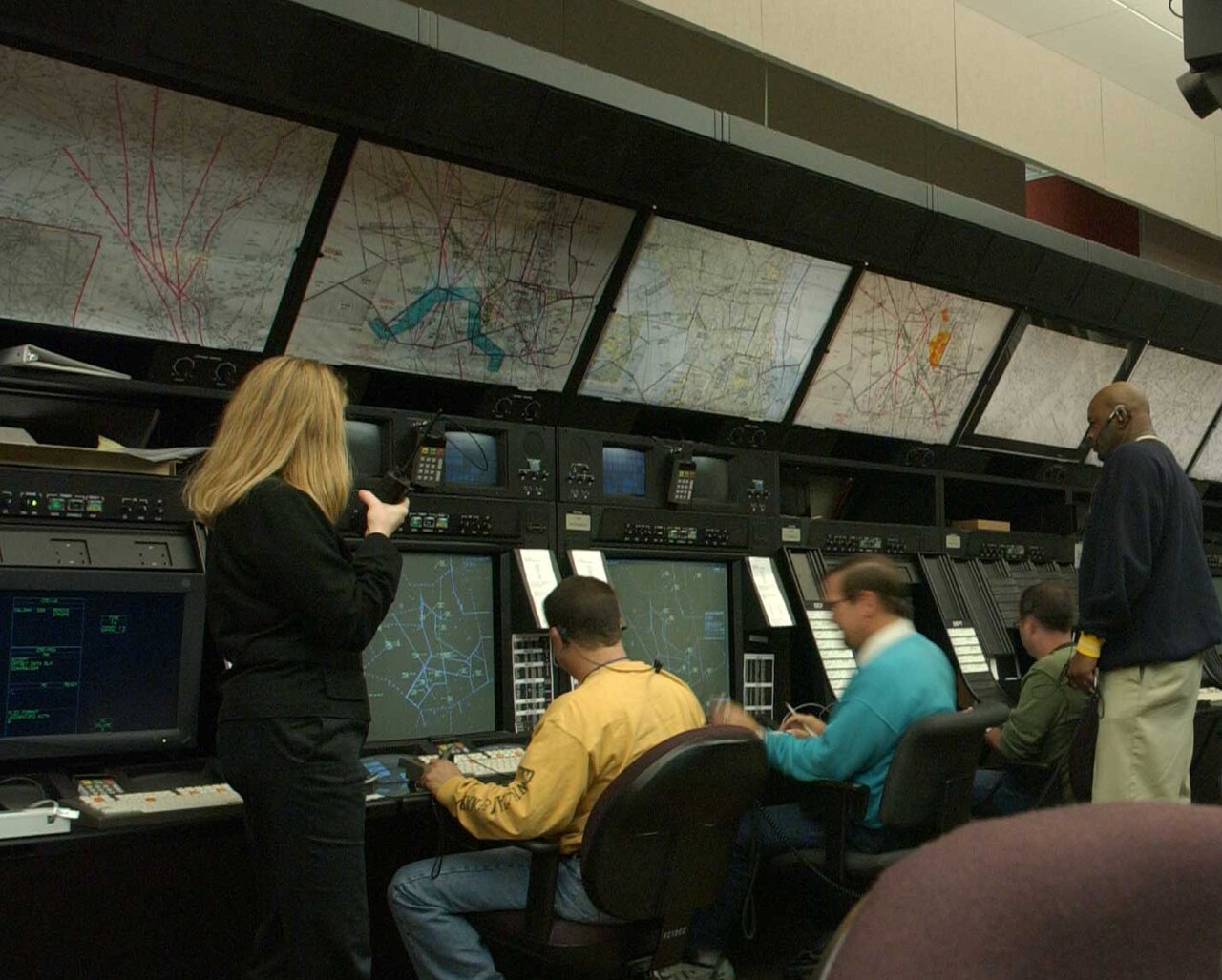
On the afternoon of November 13, 2026, a communications failure at US air traffic control centers triggered a nationwide FAA ground stop. Instability began at about 3:36 p.m. ET according to Transportation Secretary Sean Duffy. Departures were halted at about 3:54 p.m. ET by most accounts, and airspace reopened at 8:15 p.m. ET, about four hours and twenty minutes later. Reuters called it the longest national shutdown since September 11, 2001. The only other national ground stop since then was in January 2023, and it lasted about 90 minutes.
We asked six AIs (ChatGPT, Claude, Gemini, Grok, Mistral and Perplexity) the same questions in two rounds. The first round asked about the cause, the cassette story, controllers, cyber risk, money and the odds of a repeat. The second round went wider: timeline, architecture, national security, cost, passenger rights, funding, past outages and the questions ordinary people ask. This article shows what each AI said on each angle, and where they disagree.
How to read it: every AI was asked to label its claims as confirmed, official hypothesis, expert analysis or speculation. We kept those labels. A claim that only one AI makes, without a source we could check, is marked as such.
What is confirmed
- Transportation Secretary Sean Duffy said switches and routers were "overloaded with data" and produced inconsistent data, so the system was shut down. He said radar and communications were never completely lost.
- Homeland Security Secretary Markwayne Mullin said there was "zero evidence" so far of a cyberattack or rogue AI. Investigators had not ruled either out, and he said "it appears this was mechanically driven." The NSA is helping investigate.
- Two airline officials said the affected network appeared to be overseen by L3Harris. This is not officially confirmed.
- Reuters describes a system with aging technology and a shortage of several thousand controllers.
What is not known
The root cause. "Overloaded with data" describes a state, not a trigger. It could be a hardware fault, a software defect, a configuration change, a capacity limit or an external event. Every AI named this as the main unknown, and Claude flagged the sharpest version of it: whether the overload is the cause or only a symptom of something upstream.
1. Timeline: what the six AIs say
The AIs mostly agree on the shape and disagree on minutes.
| AI | First symptoms | Ground stop order | Reopened |
|---|---|---|---|
| ChatGPT | about 3:36 p.m. ET (Duffy) | 4:00-4:11 p.m. | 8:15 p.m. |
| Claude | shortly after 3:30 p.m. (Duffy) | 20:54 UTC (3:54 p.m. ET) | 01:15 UTC (8:15 p.m. ET), about 4 h 21 |
| Gemini | not stated (first-symptom time flagged as unverified) | 3:54 p.m. | 8:15 p.m., after 4 h 21 |
| Grok | about 3:36 p.m. | 3:44-3:54 p.m. | 8:15 p.m. |
| Mistral | shortly after 3:30 p.m. (Duffy) | 3:54 p.m., first at Chicago O'Hare and Midway | 8:15 p.m. |
| Perplexity | 3:36 p.m. (Duffy) | 3:45 p.m., with a note that another source says 3:54 p.m. | about 8:15 p.m. |
Five of six place the order at about 3:54 p.m. ET and the reopening at 8:15 p.m. ET. ChatGPT is the outlier on the order time. The AIs also disagree on how many flights were affected.
- Claude, citing Flightradar24: more than 4,700 cancellations and about 10,000 delays on Friday, plus about 700 cancellations on Saturday.
- Perplexity: more than 4,700 cancellations and about 10,000 delays, and another source with 6,600 cancellations and 8,600 delays.
- Mistral: nearly 8,000 cancellations and more than 10,000 delays on Friday, plus more than 2,500 on Saturday, from FlightAware figures.
- ChatGPT: "nearly 10,000 cancellations" by 11:30 p.m., which conflicts with the others and may mix cancellations with delays.
- Airborne aircraft: 3,500 (Duffy, per Claude and Grok), 4,042 (Flightradar24) or about 3,000 landed (Mullin).
We treat all counts as approximate and tracker-dependent. Several AIs also disagree on whether there were 21 or 22 affected or existing en-route centers, and nobody gave a confirmed number of affected passengers.
2. Architecture: how one failure can become national
The US system has three layers. About 22 en-route centers (ARTCCs) handle high-altitude traffic. Terminal approach centers (TRACONs) handle arrivals and departures around cities. Airport towers handle the runways. Automation systems, a separate NOTAM notice system and a shared telecommunications network tie them together.
- ChatGPT: "Geographically distributed but operationally interconnected." A shared network or software platform can disrupt otherwise independent facilities at once.
- Gemini: The FAA network, operated by L3Harris, carries voice, radar and data feeds for more than 4,400 facilities. A routing loop, a bad update or a core switch overload can degrade voice links across several centers at once. Without reliable links, controllers cannot safely accept handoffs, so departures stop nationwide.
- Mistral: Cites CBS reporting that out-of-sync packets from failing routers produced static on voice lines and blank screens in several centers. A 2023 FAA-commissioned review reportedly warned that obsolete technology on this network could disconnect "an entire regional air traffic control center."
- Claude: Names the same layers and a shared telecom backbone. It also cites the GAO on copper wiring from the 1960s and several simultaneous changes. It notes some controllers reportedly do not accept Duffy's explanation.
- Grok: Copper and TDM circuits, increasingly fiber. Overloaded legacy switches propagate nationally because centers depend on those links for consistent data.
- Perplexity: About 130 TRACONs and hundreds of towers; a shared infrastructure failure explains national propagation. NOTAM is a separate system, as in 2023.
Common ground: the failure was in something shared, not in every radar at once. This is expert analysis, not a confirmed account of this event. Two AIs (Mistral and Gemini) repeat the network-update, reboot and crash story from news sources. We could not confirm it, and we kept it out of the confirmed facts.
3. National security
- Gemini: The NSA and DHS are assisting. The FAA and NORAD share radar feeds and interception protocols. Foreign services study such outages. Claims of sabotage, a "rogue AI" or a link to a Microsoft outage on November 12 are unsubstantiated and dismissed by officials.
- ChatGPT: A civilian ground stop does not mean air defense failed. The incident shows a critical-infrastructure resilience problem even without hostile action.
- Claude: Cites Mullin saying "not another 9/11." It reports that AirSpace Intelligence, a contractor on an AI traffic-management system that had expanded on November 10, says the outage was not due to its system. Claude found nothing on NORAD.
- Mistral: Sen. Richard Blumenthal called the outage "a clear danger to national security." A physical or cyber attack on the aging network is a plausible adversary playbook, but nothing indicates one happened.
- Grok: Zero evidence of an attack. Adversary interest is a known concern, but any exploitation of this outage is speculation.
- Perplexity: Mullin said "zero evidence" and "nothing completely certain." Reports say the FBI is looking at a software update, which remains unconfirmed.
All six say the same thing: no evidence of hostile action, and the vulnerability was shown, not exploited. "Zero evidence so far" is not a clearance, and it is not proof of an attack either. Forensic attribution takes far longer than a day.
4. Financial impact: five guesses, no official figure
No official cost has been published. The AIs gave their methods and ranges. Perplexity gave none.
| AI | Range | Method |
|---|---|---|
| Grok | airlines $100-400 million, plus tens of millions for passengers | cancellations times past cost per flight |
| ChatGPT | $300 million-$1.5 billion total | three buckets of $100-500 million each: airlines, passengers, wider economy |
| Gemini | $350-900 million total | $98.41 per block minute (Airlines for America), $63.95 per passenger hour (FAA), about 1.5 million travelers |
| Mistral | airlines $300 million-$1 billion, passengers on top | the 2023 outage as a benchmark, scaled up for the weekend backlog |
| Claude | airlines $200-800 million, wider economy $500 million-$2 billion | past outages and per-day airline cost benchmarks |
The bottom of the range is $100 million and the top is $2 billion in the widest case. These are scenario estimates, not accounting. Every AI that gave a number said so. Counting every delayed passenger's time as cash would overstate the immediate damage. We found no data on stock moves, and none of the AIs gave any.
5. Passenger rights
The AIs agree on the core and differ on details.
- Refund: All AIs that answered say US passengers are owed a full refund to the original payment method if they decline the alternative flight or credit, whatever the cause.
- Meals and hotels: All say federal law does not require them for an FAA-caused cancellation. Airline commitments cover "controllable" cancellations, and air traffic control is not controllable.
- Gemini's detail: A refund is also due after a domestic delay of three hours or more if you decline to travel, within 7 business days for a credit card.
- Cash compensation: Not required in the US.
- EU rules (EC 261): The right to care, meaning meals and a hotel if stranded, remains. Fixed compensation of 250-600 euros is generally excluded when air traffic control is an extraordinary circumstance.
Practical result for a US passenger on 13 November: a refund if you give up the trip, and everything else is airline goodwill. We did not check this against DOT primary pages.
6. Funding: three figures that are not the same money
This is where the AIs and the press disagree most, and where we found the most confusion.
| Figure | What it is | Status |
|---|---|---|
| $12.5 billion | Modernization funding over five years, enacted in 2025 | Approved. Several AIs and Reuters cite it. Claude adds that about $2 billion of it goes to a first new en-route center in decades. |
| about $30 billion (Reuters: $30.1 billion) | A further request, split into three roughly equal parts for towers, technology and airports | Requested before the outage, not approved |
| $50 billion | The estimated cost of replacing the whole system | Cited after the outage. Reports differ on whether Mullin estimated it or Duffy requested it |
- Claude could not source a $30 billion request in its own search. It found $19-20 billion of additional need cited by Duffy, a $10 billion next phase in April 2026, and a $20 billion coalition request in July 2026. About $4 billion a year, it says, goes to maintaining the old system.
- ChatGPT gives the clearest breakdown: the $30 billion Modern Skies Act proposal of September 2026, split in three parts of $10 billion.
- Gemini and Grok cite the $12.5 billion as a "down payment" for replacement radars, radios, electronic flight strips and copper-to-fiber upgrades, with a target of December 2028.
- Mistral says it did not re-source the $12.5 billion and $30 billion figures and flagged them as unverified.
What the money buys, according to the AIs: new telecom links, radar, automation and towers. It does not buy speed. Procurement, testing and cutover on a live safety-critical network take years, and Duffy is quoted as saying "you will have more of these" in the meantime. Do not add the three figures together. They are stages, not a total.
7. Comparisons and the risk of a repeat
All six AIs list the same three comparison cases.
- January 2023, FAA notice system: a contractor deleted database files while fixing a synchronization problem. About 90 minutes of ground stop, more than 10,000 delays. Cyberattack was ruled out.
- April-May 2025, Newark and Northeast: telecom and radar-display outages at the Philadelphia TRACON, including about 90 seconds on May 9. Regional, not national. Gemini links one to a burned copper wire.
- August 28, 2023, UK NATS: a flight plan with two identically named waypoints triggered a fault, and both primary and backup systems went into fail-safe mode. The UK regulator estimated more than 700,000 affected passengers. (Mistral dated it May 2023, which is wrong.)
The common thread, in the AIs' words: old, centralized, tightly coupled systems where one fault cascades. Claude and one web source also mention a September 2026 telecom failure in the Northeast.
Round 1 and round 2 probabilities
| AI | Round 1: another nationwide stop in 12 months | Round 2 |
|---|---|---|
| ChatGPT | 5-15 % | 5-15 % |
| Claude | 8-20 % | 5-15 % |
| Mistral | 5-15 % | 10-25 % |
| Perplexity | 10-25 % | not recorded |
| Gemini | 15-35 % | 15-30 % |
| Grok | 15-35 % | 10-40 % |
The answers differ by a factor of seven or more, and some AIs moved between rounds. Every model also named its own probability as a judgment, not a measurement. That is the honest result: with two national ground stops in 25 years and an unknown cause, no one can calculate a trustworthy number. All of them add that a regional disruption is considerably more likely. We would treat none of them as a forecast.
What would move the estimate, according to the AIs: a root cause that is systemic and not yet fixed would raise it, while an isolated fault that is identified, patched and backed by working failover would lower it.
8. The questions ordinary people ask
We asked each AI for the five questions people would ask, with one honest sentence each. These came up most often.
- Was it safe for the planes in the air? Five of six say yes: airborne aircraft stayed under controller contact and landed. ChatGPT adds that the ground stop was a safety response, not a sign aircraft were falling out of the sky.
- Was it a cyberattack? Officials say zero evidence so far. Not the same as proven impossible.
- Do I get my money back, and a hotel? Refund yes if you give up the trip. Hotel and meals no, unless the airline offers them.
- When will things be normal? Duffy said by Thanksgiving. Backlogs ran into Saturday, and nobody can say exactly when the last disruption ends.
- Why is the system so old, and will it happen again? Copper, legacy switches and partial funding. Yes, possible, but another nationwide stop is less likely than regional ones.
Where the six AIs agree and disagree
Agree: the cause is unknown; the cassette story is a media simplification; staffing is context, not cause; no evidence of an attack, but not a clearance; refund yes, hotel no; money will not help soon.
Disagree: the minute the ground stop began; the number of cancellations; the dollar cost; which figure for funding is real and who said what; the probability of a repeat.
The cassette myth
Some coverage mentions very old storage media. Nothing in the confirmed facts links tapes or cassettes to this outage. The failure described involves switches and routers, which move data in real time rather than store it. All six AIs called the storage-media story a media simplification. The real context is that the system relies on aging technology in general, and that is a different claim.
Controllers: context, not cause
The shortage of several thousand controllers is documented. No evidence ties it to a network or data failure, and all six AIs treated it as context. Two of them added that it may reduce the system's ability to cope once something goes wrong. That is speculation.
The Satcove verdict
Six independent AIs agree on the shape of the story and disagree on every number that sounds useful: the minute it started, the flight count, the dollar cost, the funding, the odds of a repeat. When AIs disagree that widely, the disagreement is the information. The one thing nobody has is the cause, and until it is published, every cost, risk and funding figure here is an estimate about an event nobody can yet explain.
Method, sources and limits
- Each AI got the same prompt in each round, built from the Reuters report of November 13, 2026, and answered once per round, through its web account, with no temperature control. In round 2, Gemini, Mistral, Claude, Perplexity and Grok searched the web and ChatGPT cited sources; capability differs by account and mode, so the answers are not equally sourced.
- AIs can mislabel facts. In our run, one model dated the UK outage to May instead of August 2023, one gave a cancellation count that conflicts with every tracker, and one gave a 2023 cancellation figure far below other sources. We corrected for these in this article.
- Several claims made by individual AIs are not confirmed and are kept out of the confirmed facts, including a report of a network update followed by a reboot and a crash, a Cisco router theory, a link to an AI traffic-management vendor.
- Cancellation counts, the start time of the ground stop, the number of affected centers and the origin of the $50 billion figure differ between sources. We present them as ranges.
- We checked the main facts against secondary reporting. We have not verified them against FAA, DOT or Congressional documents, and we found no stock-market data.
- The cost, probability and funding-outcome figures are AI estimates, not Satcove forecasts.