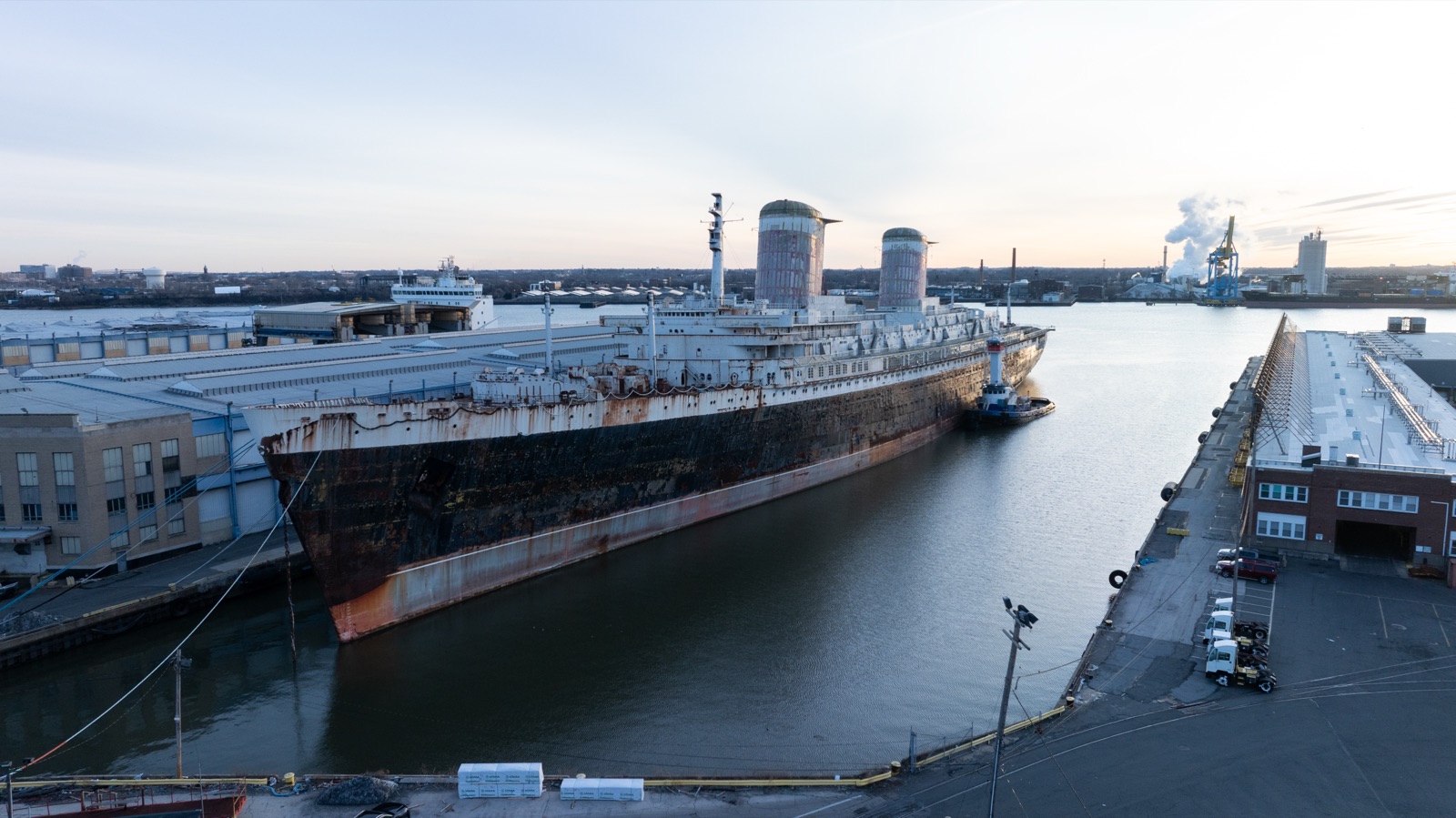
The SS United States, the American liner that took the transatlantic speed record in 1952, was sunk off Florida on the evening of Wednesday, November 11, 2026, to become what its backers call the world's largest artificial reef. We put the same questions to six AI assistants and kept every answer. They agree on a word, "repurposing", but not on what "largest" means, what "success" would be, or what the date says about the project.
Where things stand
The ship was planned to go down about 22 nautical miles southwest of Destin–Fort Walton Beach, in roughly 180 feet of water, with the top deck 55 to 60 feet below the surface, according to Okaloosa County's FAQ. The date was first set for Thursday, November 12, then moved up a day because of a heavy-wind forecast (Local 12, CBS Philadelphia). ABC and PBS reported that she sank late on November 11 and came to rest on the Gulf floor (links below). We did not witness it and did not read the county's own statement. The six AI conversations were run before the sinking, on the plan and the public record as of November 11, and the models could not report the outcome.
What the six answered, in brief
- On the label: all six chose "repurposing" when forced to pick one of tribute, repurposing or neither. None chose tribute or neither. The prompt allowed one pick only.
- On "largest": all six anchor the claim in the ship's 990-foot length against the USS Oriskany. They disagree on the verdict, from "marketing exaggeration" (Gemini) to "accurate for shipwreck reefs" (Grok).
- On ecology: probabilities of success range from about 60% to about 75%, but they measure different events over different horizons.
- On the date: five answers say the weather, not symbolism, moved the sinking to November 11. Claude says the same about the sinking but leaves open why the send-off was planned for that day.
A ship built to be the fastest
The SS United States was designed by William Francis Gibbs. She is 990 feet long, with a 101-foot beam and an aluminum superstructure, and was designed so she could be converted to a troop transport (SS United States Conservancy). She was launched in 1951. On her maiden voyage, which began July 3, 1952, she broke the transatlantic speed record in both directions. She was withdrawn from service in 1969 and held in the Navy reserve until 1978.
The Conservancy bought her in 2011, helped by $5.8 million in gifts. Pier rent in Philadelphia doubled in 2021 and an eviction suit followed in 2022. In October 2024 she was sold to Okaloosa County. Conservancy pages we read disagree on when she left Philadelphia, so we do not give a date.
Reuse or tribute?
Asked to choose, every AI said "repurposing". The reasons are close. The county bought her to make a reef after other plans failed (Mistral, citing Okaloosa's FAQ). Claude says officials presented the alternative as the scrapyard and calls the museum "the part that could be called a tribute". ChatGPT notes the funnels, mast and artifacts kept for a museum "add a commemorative element". Perplexity calls the Veterans Day and "saving the ship" language "commemorative, not the operative purpose". Mistral goes furthest: tribute language is "marketing around a functional reuse".
Two things limit this agreement. The question forced a single pick, so we cannot say what the models would say if allowed "both". And in round 1, Claude, asked for the best case on each side, wrote that "tribute" is "defensible only if the museum, the archive and the interpretation are sustained". The county has said a land museum is planned, with no site or date announced in what we read. That is the part to watch.
The largest reef: by what measure?
All six rest the claim on length: 990 feet against the Oriskany, scuttled off Pensacola in 2006. They disagree about how far it goes.
- Gemini calls it a marketing exaggeration and, alone among the six, says the Oriskany has greater mass and volume. It names no source for that.
- Perplexity says it is "narrow and only partly accurate", notes that Guinness still lists the Oriskany, and cites Wikipedia displacement figures that put the liner heavier. It says it found no published volume, deck area or seafloor-coverage figure.
- ChatGPT, Mistral, Grok and Claude call it accurate with a qualifier: for single ships sunk as reefs, or by length.
The sources also disagree on the Oriskany's length: 888 feet (Gemini, Claude from memory, Guinness as cited by Perplexity) or 911 feet (ChatGPT, Mistral, the AP comparison as reported by Perplexity). We did not settle it. "Largest" is a length claim until someone publishes a volume or area measure.
Ecological success: not the same test
Nobody claims it is already a success. They differ on what success means:
- Perplexity separates colonization (about 70% within a year, its estimate) from "demonstrated net habitat gain" (about 45%).
- Mistral gives about 70% for "clear ecological success" and says new biomass versus displaced fish is the open question.
- ChatGPT gives 60% and says fish around the wreck show colonization, not necessarily increased fish populations.
- Claude gives about 60% for a "stable, productive habitat".
- Grok gives 65–75% for "moderate ecological success".
- Gemini gives 65–70% for local habitat and calls net expansion of natural reefs "low".
These numbers are subjective model estimates, not scientific measurements. They cover different events and horizons and should not be averaged. ChatGPT's source for planned monitoring is the county's remediation page: baseline and post-sinking studies with Woods Hole Oceanographic Institution and partners, and a ten-year program, per ChatGPT and Perplexity. We have not read those pages.
Was the date chosen for its symbolism?
Satcove supplied the premise that the sinking was held on November 11, which later reporting bore out. The question was whether the date was deliberate. Five answers say the weather moved it, and the symbolism came afterward. Claude says the sinking date was probably not chosen for symbolism, but that no source it found explains why a send-off was planned for that day, so a deliberate link there is "possible but unproven".
One quote circulates in the answers. Mistral, Grok and Perplexity attribute to county Board Chairman Trey Goodwin the remark that the weather "has given this historic occasion an especially meaningful date". We saw it only through those answers and through the news coverage we could read, not in the county's own text. We found no source tying the date to Armistice Day in Europe. Mistral calls that link "only a reader-side coincidence". Perplexity says a planned public send-off on November 11 was canceled; ChatGPT, Gemini and Claude say a send-off was planned for that date; Mistral and Grok do not mention it.
What the AIs propose for a second life
The answers do not offer a shared plan, and we do not fill that gap. What they point to: sustained museum and interpretation (Claude), multi-year before-and-after monitoring with control sites (ChatGPT, Mistral, Perplexity, Claude, Grok), and caution about promised tourism figures (Grok and Claude name them as the claim they trust least). These are the models' recommendations. The measures that exist are separate: the county's remediation work and the research program announced with Woods Hole.
Facts, interpretations, open questions
Facts we read: the plan, the depth, the cost reported at about $13 million from a tourism bed tax, the move from November 12 to 11 for wind. Reported by others, not checked by us: that the ship sank on the evening of November 11 (ABC, PBS).
Interpretations: that this is "repurposing", that "largest" means longest.
Open: how the ship settled on the bottom and what the post-sinking surveys find; whether a land museum opens and where; what the monitoring finds; the Oriskany's true length and any volume comparison; the outcome of a lawsuit filed in Pensacola federal court by a "New York Coalition" (reported by CBS in 2025), which we could not trace.
How we did this
Each AI was asked three rounds, all in English: a different angle for each in round 1, then identical questions in rounds 2 and 3. We kept every answer verbatim. Source panels, links and cards were not saved. Model labels were unclear for five of the six. Satcove's questions shaped the answers: a forced single pick on tribute, and a stated premise about the date, given before we had confirmed it. The AI that drafted this article is Claude, one of the six. The full answers are archived by Satcove and are not reproduced on this page.
Sources
- Okaloosa County, SS United States FAQ: https://myokaloosa.com/SSUSFAQs
- SS United States Conservancy: https://ssusc.org/fast-facts · https://www.ssusc.org/history-the-glory-years · https://www.ssusc.org/history-retirement · https://www.ssusc.org/our-history · https://www.ssusc.org/museum-and-visitor-experience-plans · https://www.ssusc.org/the-ship
- Local 12, sinking moved up: https://local12.com/news/nation-world/okaloosa-county-moves-ss-united-states-sinking-up-to-wednesday-amid-heavy-wind-forecast
- CBS News Philadelphia: https://www.cbsnews.com/philadelphia/news/ss-united-states-sinking-date-florida/ · https://www.cbsnews.com/philadelphia/news/ss-united-states-artificial-reef-2026-florida/
- Reports of the sinking, not read in full by Satcove: ABC / 6abc, https://6abc.com/post/how-watch-ss-united-states-sinking-vessel-takes-final-journey-become-worlds-largest-artificial-reef-florida/20028524/ · PBS NewsHour, https://pbs.org/newshour/nation/watch-live-ss-united-states-once-worlds-fastest-ocean-liner-sinks-to-become-reef-off-florida
- The six AI conversations, archived by Satcove.
Photo: the SS United States at her Philadelphia pier on the morning before her tow out, February 19, 2025, by WSRower via Wikimedia Commons (CC0).