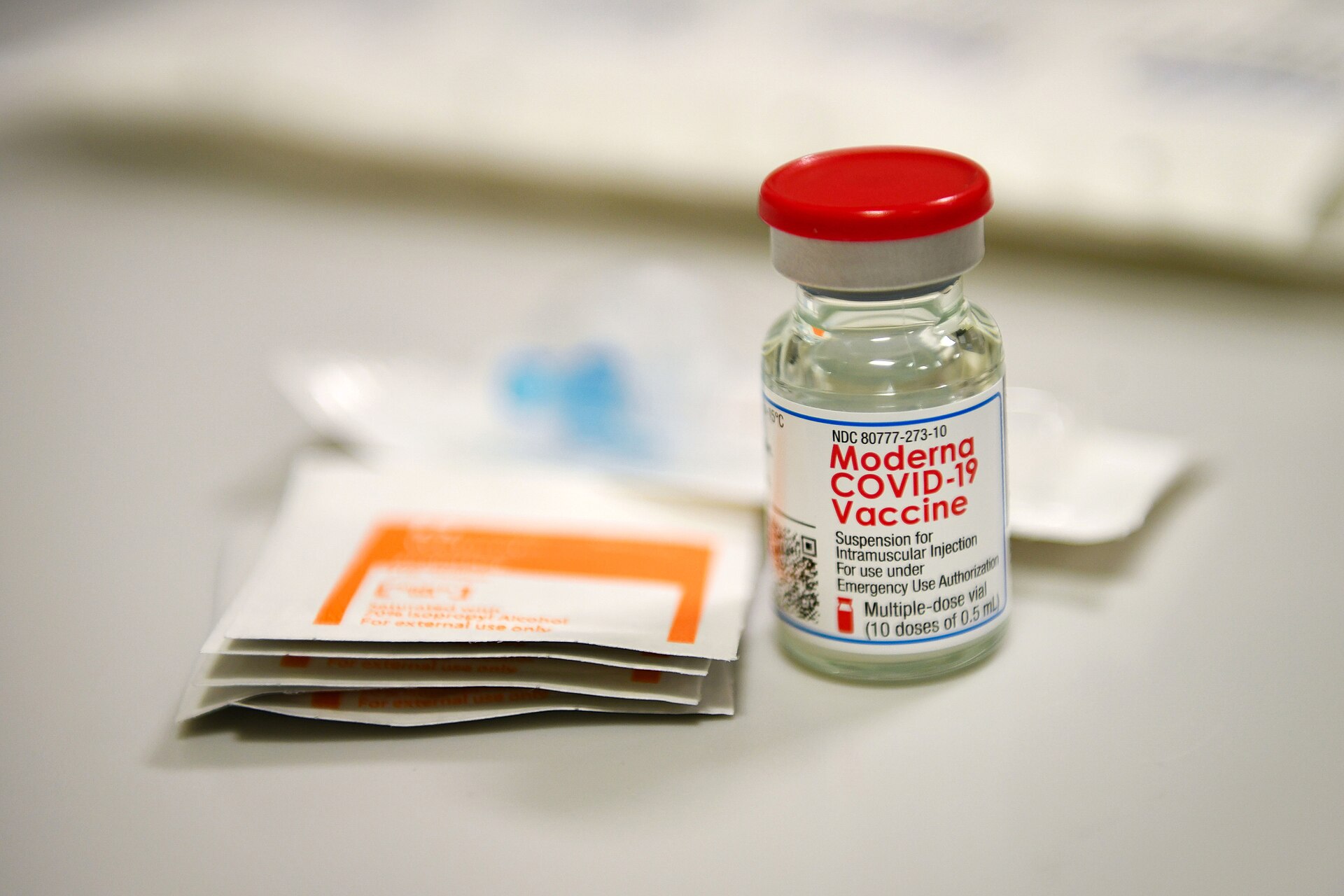

The personalised mRNA vaccine intismeran autogene (Moderna and Merck), given with pembrolizumab, lowers the risk of relapse in resected high-risk melanoma. That is the finding of the phase 3 trial INTerpath-001. The more interesting question is the role of artificial intelligence in choosing the vaccine's targets. The trial does not isolate that contribution, so nobody can yet say what AI adds beyond a conventional selection.
Sourcing note. We could not read the Courrier International article that prompted this piece. The text relies on English-language reports, company releases and coverage of the ESMO 2026 congress. We did not read the full NEJM paper. Figures labelled as company figures were not independently verified.
What the phase 3 shows
INTerpath-001 randomised 1,137 patients 2:1 (757 vaccine, 380 placebo) after surgery for stage IIB to IV melanoma. Everyone received pembrolizumab (Keytruda), with either the vaccine or a placebo, double-blind. Results were presented at ESMO 2026 on 24 October (LBA1) and accepted by the New England Journal of Medicine. We found no online text.
- Primary endpoint: recurrence-free survival (RFS). Hazard ratio 0.58 (95% CI 0.45-0.75, p<0.001), a 42% relative drop in the risk of relapse or death. At 24 months, 82.2% of vaccinated patients were recurrence-free against 70.0% in the control arm. Median follow-up was 24.6 months.
- Key secondary endpoint: distant metastasis-free survival (DMFS). Hazard ratio 0.62 (p=0.002), or -38%. The testing plan was hierarchical: RFS, then DMFS, then overall survival. So there is one primary endpoint and one key secondary, not two primary endpoints as some releases suggest.
- Overall survival: immature. Hazard ratio 0.77 (95% CI 0.45-1.31, p=0.33), not significant. No survival gain is shown.
- Timing. In the first six months the curves almost overlap (hazard ratio about 0.99). The effect appears afterwards: the hazard ratio is 0.42 after six months, from a prespecified sensitivity analysis reported by Moderna.
- Safety. Grade 3 or higher adverse events: 23.6% with the vaccine against 20.3% with placebo.
- Manufacturing. More than 99% of vaccine-arm patients received a vaccine. Upstream, 302 of 1,749 patients assessed (17.3%) were excluded for insufficient tumour tissue.
The 42% is a relative reduction in risk, derived from a hazard ratio. It does not mean 42% fewer relapses. The absolute gap at 24 months is 12.2 points (82.2% against 70.0%).
The earlier phase 2b KEYNOTE-942 (157 patients, median follow-up 60.3 months, published in the Journal of Clinical Oncology) points the same way: RFS -49% (hazard ratio 0.51, 95% CI 0.294-0.887) and distant metastasis-free survival -59%. Overall survival, an exploratory analysis, gives a hazard ratio of 0.471 (95% CI 0.165-1.345), not significant, with 7 deaths in each arm. The numbers are too small to conclude.
A vaccine built from each patient's tumour
The removed tumour is sequenced. Mutations that produce proteins absent from healthy cells, called neoantigens, are identified. A selection of these targets is encoded in messenger RNA, which trains the body to recognise them in the hope of destroying remaining tumour cells. Each vaccine is unique. Manufacturing time depends on the process and we give no figure without a solid source, but it raises cost and logistics questions.
The real role of AI: sorting targets
A tumour can carry hundreds of mutations, but only a small share produce neoantigens that T cells actually see, presented by the patient's HLA molecule. Predictive models estimate which ones will be.
For intismeran, a paper presented at ASCO describes a "deterministic" machine-learning bioinformatics algorithm that takes the patient's HLA into account. The code, parameters and validation are not public. The trial does not compare AI selection with non-AI selection: the benefit measured is that of the whole vaccine, not of the sorting method.
That prediction is an intermediate step. It measures neither the effect on the tumour nor survival. Two other programmes show very different levels of evidence:
- EVX-01 (Evaxion): a peptide vaccine, not mRNA. Phase 2, 16 patients, single arm, with pembrolizumab. Reported objective response rate: 75% (12 of 16, including 4 complete responses). The company says 86% of targets chosen by its AI platform produced a potent T-cell response (three-year data) and later communicated 89% "vaccine target precision". These are company figures with no comparison group.
- EVM16 (Everest Medicines): phase 1, 9 patients with advanced solid tumours, not melanoma, combined with tislelizumab. T-cell responses in 8 of 9 patients and one confirmed partial response, in a patient with gastro-oesophageal junction cancer. Too small to conclude on efficacy. The algorithm is proprietary.
What an immune response does not prove
A measurable T-cell response shows that a target was recognised. It does not show that the tumour shrank or that the patient lives longer. Several mechanisms can separate the two: tumour heterogeneity, immunoediting that selects cells able to hide, T-cell exhaustion, the immune microenvironment. A prediction system can sort targets correctly without improving the final result.
What remains uncertain
- Overall survival is immature and not significant.
- The vaccine is not FDA-approved. Moderna's third-quarter 2026 communications say submissions are in preparation. Secondary sources mention a filing by end 2026 and an approval target in 2027, with no guarantee of timing or decision.
- The contribution of AI itself is not measured.
- The cost of individual manufacturing, reimbursement and access remain open.
- 17.3% of patients assessed for the trial were left out for lack of tumour sample, a detail that matters for real-world use.
What AI will have to prove
AI probably has a practical use: it cuts the number of targets to test and speeds up design. That does not let us judge it on clinical results. Three proofs are missing.
First, that its predictions hold in independent cohorts, with published, reproducible methods. Second, that the chosen targets produce a durable immune response. Third, and above all, that AI-based selection improves survival compared with standard selection, which neither INTerpath-001 nor the Evaxion and Everest studies test.
Verdict: a solid result on relapse, an effect on survival not demonstrated, and a plausible but unisolated role for AI.
What six AIs said about the first version of this article
Before publishing, we gave an earlier version of this text to six AI assistants (ChatGPT, Gemini, Claude, Perplexity, Mistral, Grok) with the same brief: score the article out of 10, list its weaknesses, check the facts with a web search, propose three corrections. Here is what they answered, errors included. These are model outputs, not sources: we cross-checked them against the press releases and reports cited above, and we did not read the full NEJM paper.
The scores.
- Claude: 6.5/10
- ChatGPT: 8/10
- Gemini, Perplexity, Mistral: 7.5/10
- Grok: 8.5/10
Two points apart for the same text. The harshest score also came from the review that found the most substantive problems.
Where they agree. Five of the six call the article cautious, and most flag that "no peer-reviewed publication" was out of date: the results were presented at ESMO on 24 October 2026 and accepted by NEJM. Several ask for the absolute gap (82.2% vs 70.0% at 24 months) next to the relative 42%.
Where they diverge.
- Primary endpoint. Gemini, Claude and Grok correct "two primary endpoints": recurrence-free survival is the primary endpoint, distant metastasis-free survival a key secondary. Mistral marks the claim "verified". We followed the first three.
- Approval estimate. Claude calls one oncologist's estimate "unverifiable" and suggests replacing it with company guidance. Grok calls it "verified". We dropped the personal estimate.
- EVM16 partial response. Mistral says the partial response is "not confirmed by [its] sources". ChatGPT, Claude and Grok confirm it (one patient, gastro-oesophageal junction cancer, not melanoma).
- The role of AI. Only Claude challenges the title, which credited AI with an effect the trial does not test. That critique changed the text most: the title and angle were rewritten.
Errors and slips.
- Gemini mixes two KEYNOTE-942 figures: it gives a hazard ratio of 0.56 (−44% at three years) for a study whose five-year figure is 0.51 (−49%), and labels it all "verified".
- Mistral validates an error on the endpoints and adds items (a 2024 FDA accelerated-pathway refusal, market reaction) that we could not verify and did not use.
- ChatGPT first answered without having received the article, asking us to paste it. It had to be re-prompted.
- Perplexity alone notes that "overall survival not published" was inaccurate for KEYNOTE-942, whose overall survival analysis is published (hazard ratio 0.471, not significant).
- Claude alone noticed that 302 of 1,749 patients (17.3%) were excluded from the trial for lack of tumour tissue. We added it.
What this shows. No single review is enough. The most generous one let a substantive error through, and the harshest was the most useful. A figure an AI calls "verified" can be a blend of two studies. Only cross-checking several outputs and the sources catches these gaps, and it does not replace reading the primary paper.