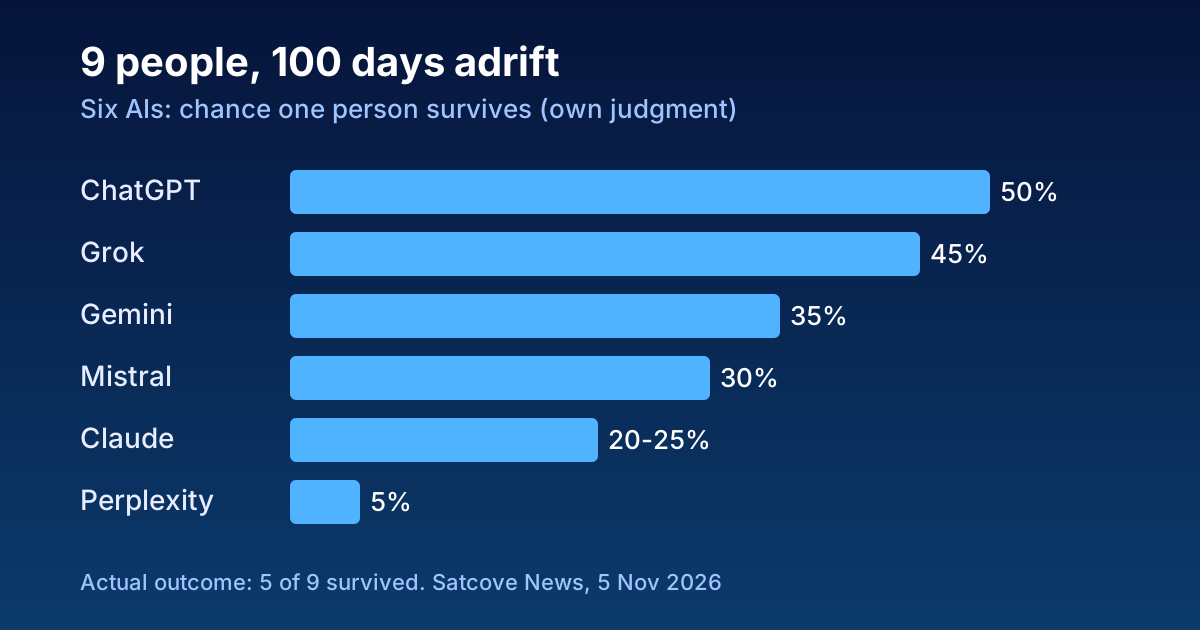
Nine relatives set out on a trip of about an hour. About 100 days later, five of them washed up alive on a remote island. Around 1 November 2026, a 20-foot skiff reached Fanning Island in Kiribati, thousands of kilometres from where it left. Satcove asked six AI models three questions about it: how likely was survival, what does group size change, and could AI have found the boat. Figures below are the models' own judgments from 5 November 2026, not measured statistics. Facts come from public reporting, listed at the end.
What happened
On 30 July 2026, nine members of one family left Murilo, in the Federated States of Micronesia, bound for Ruo, a trip of about an hour. The skiff ran out of fuel, lost steering and drifted. It had no locator beacon, according to the US Coast Guard in Guam. The Coast Guard searched by air and sea over about 25,000 square nautical miles, roughly 86,000 km2. After about ten days without a sighting, the effort ended. The survivors say they saw ships and planes that did not see them. Around 1 November the skiff reached Fanning Island. Five people were alive and four had died, including a child, according to the New York Times. The survivors drank rainwater and caught birds and turtles, according to witnesses on the island. Reports differ on the distance (more than 3,000 miles in the New York Times, about 5,400 to 5,500 km elsewhere), on the exact landing day, and on whether the four others were confirmed dead. We use the New York Times account and flag the differences.
How likely was survival, according to six AIs
We asked each model the same question: how likely is it that one person survives about 100 days adrift in a 20-foot open skiff in the tropical Pacific, with rainwater and caught food.
| AI | Central estimate | Range |
|---|---|---|
| ChatGPT | 50% | 20-70% |
| Grok | 45% | 25-65% |
| Gemini | 35% | 15-60% |
| Mistral | 30% | 10-50% |
| Claude | 20-25% | 5-45% |
| Perplexity | 5% | 1-15% |
| The median is about 32%. The lowest and highest estimates differ by a factor of ten, and every model said its number was hard to calibrate. | ||
| What they share matters more than the number. Nearly all put fresh water first: how much rain the crew could collect and store. Next came age and health, since children and the weakest run out of reserves first, then sun, storms and the risk of capsizing. | ||
| All six warn about the same bias. We only learn about boats that were found. Cases where nobody came back leave no record, so the observed 5 of 9 (56%) is likely too optimistic as a general rate. | ||
| One limit of our method: we gave the models the real outcome. Some used it as an anchor, so their percentages may lean toward it. |
What does group size change?
Is a crowd on a small boat an asset or a liability? None of the six claimed there is a proven ideal number. They agree on the mechanism. Needs for water and food grow with the number of people, while rain collected depends on surface and luck. More people also mean more hands to fish, bail and keep watch, and more mutual support. They also mean crowding, sanitation problems and tension. Claude noted that the survivors say they saw ships and planes without being seen. Lookout was therefore probably not the limiting factor. Visibility of a small boat was. They differ on the figure. Gemini suggested 3 to 5 adults and Mistral 4 to 6 people. ChatGPT, Claude, Grok and Perplexity declined to give a number without evidence, and pointed to the make-up of the group (age, health, skills) as probably more important than its size. We did not verify the studies Mistral cited, so we do not repeat them.
Can AI predict where a lost boat drifts?
All six answered alike, with nuances: yes, but as probabilities, never as one track. Search-and-rescue models release thousands of virtual particles driven by currents, wind and leeway, the drift of an object under wind that depends on its shape, load and heading. For a small skiff without AIS or a beacon, nothing corrects the calculation. Errors in the start position, current or wind add up day after day, and the area of probability widens. What the models say AI can improve:
- Shorter decisions: turn scattered weather and ocean data into a usable search map in minutes.
- Better handling of uncertainty: produce a bundle of trajectories with probabilities instead of a single line.
- Priority for scarce assets: aircraft, patrol vessels, drones and satellites are limited, and AI can recommend where to use them.
- Learning from past cases: feed the gaps between predicted and actual drifts back into the models.
- Earlier alerts: flag an unusual route, a lost AIS signal or a sudden storm before it becomes a disappearance. The claimed gains are unverified. Gemini said 15 to 30% less search area, Mistral 20 to 40% and 12 to 48 hours saved, Grok 20 to 40% and a few hours in the first three to five days. None cited a study, and we cannot confirm them. On this case the views split. Gemini said that after day ten, predicting a drift across the Pacific is out of reach. Mistral thought a zone of about 500 km could have been drawn, which looks very optimistic for a drift of nearly 100 days. ChatGPT, Grok and Perplexity were more cautious: a model could have refined the likeliest sectors, not named an island 5,000 km away. Grok added that without a new position, no model could reduce a 5,000 km track to a usable zone. Claude pointed to the other limit: the area would still have been huge, and far more aircraft and ships would have been needed than the 25,000 square nautical miles covered. Only Gemini offered a cause for the eastward drift, an equatorial counter-current or westerly wind bursts, and that is a hypothesis.
What we take from it
- The number is the weakest part. Estimates from 5% to 50% show that survival odds at this scale are judged, not measured.
- Agreement is on the mechanism. Water, health, exposure and survivorship bias came up in nearly every answer.
- Group size has no proven optimum. Composition probably counts more than headcount.
- AI narrows, it does not find. It can cut a search area and save hours. It cannot predict the unpredictable.
- Data and coordination decide. AI is useful only with the data, the sensors and the human coordination behind it. AI cannot predict the unpredictable. A small boat with no AIS, no beacon and no communication stays a tiny object in an immense ocean. Models must cope with errors in the start position, poorly measured local currents and changing conditions. The right conclusion is not that AI would have found the boat. It is that AI could have narrowed the search area, saved hours and raised the chance of detection, provided the data, the sensors and the human coordination were there. In this tragedy, technology was not enough. Next time, the question may not be whether AI can predict a trajectory. It may be whether several AIs, fed by weather, ocean and satellite data, can agree fast enough to tell rescuers: look here first.
Method and limits
Six models answered the same three questions in English on 5 November 2026 through their APIs: ChatGPT, Claude, Gemini, Grok, Mistral and Perplexity. We told them the facts above, including the outcome. We did not check any AI efficiency figure against a source. Percentages are the models' own judgments.