Update: no decision by Nvidia's board of directors had been announced at the time of publication. This article will be updated.
Added November 12: a second round of questions, put to the same six AIs with a different question and an extra option ("organized departure"), is presented below in the "Second round" section. Its results do not add to those of the first round.
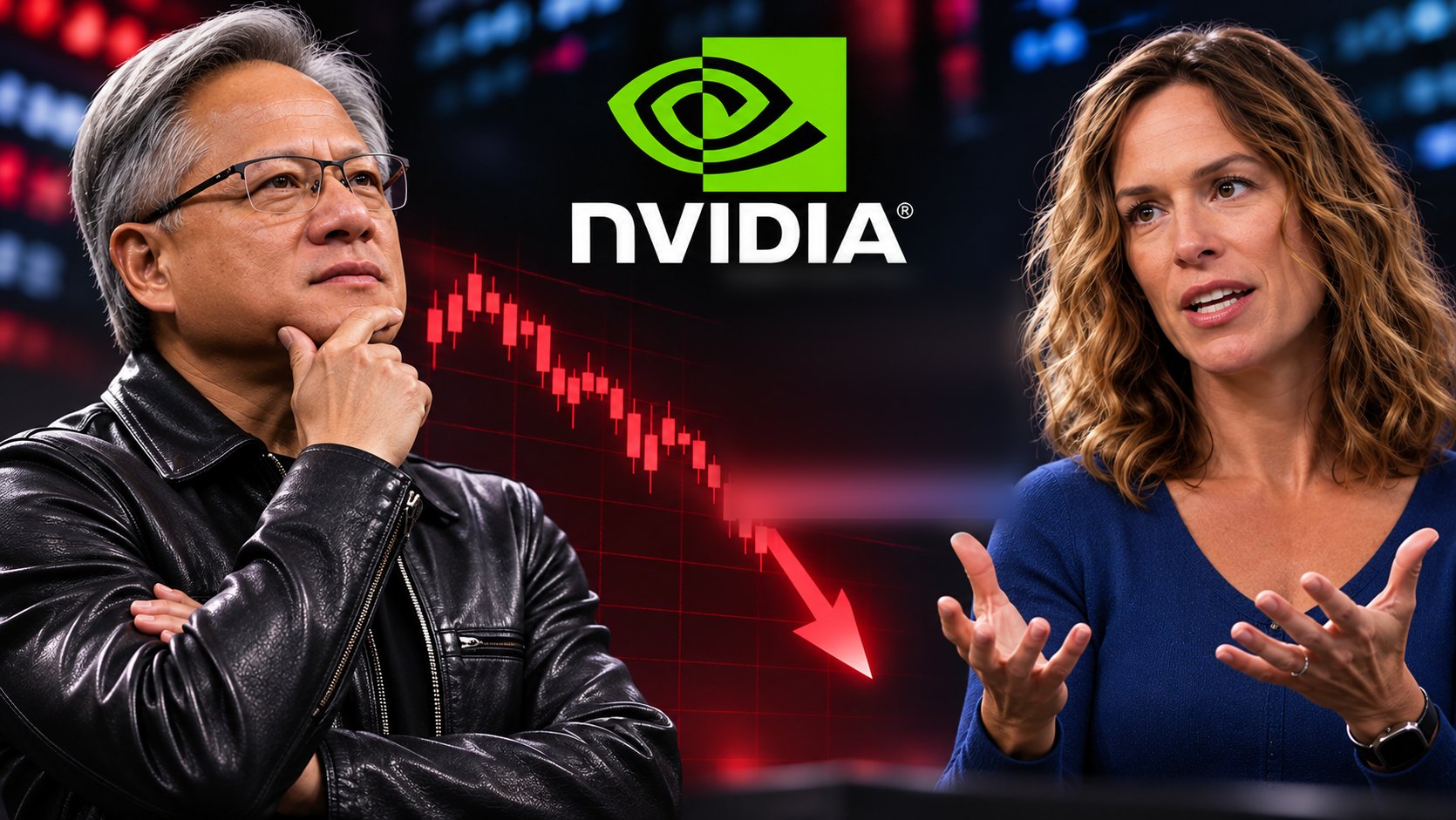
Image: illustration (composite), not a photograph.
Can Nvidia still entrust its most strategic secrets to a founder whose private life has become a geopolitical attack surface, even though no leak has been proven? We put the question, with the same sheet of verified facts, to six AI models. Five recommend keeping Jensen Huang under conditions, only one suspending him for the duration of the investigation. None recommends ousting him. Their disagreement is less about the facts than about the threshold at which a company must act on an unproven security risk.
What we know
- On November 8, Jensen Huang admitted to infidelity in a message to employees: "I was unfaithful to my wife. My actions hurt her and our children. There is no excuse for what I did." He named no one (CNBC, CBS News, Al Jazeera).
- The same day, the board launched an independent investigation led by a committee of independent directors assisted by outside counsel. It said it had "no reason to believe" that national security or Nvidia's secrets had been compromised, while specifying that the investigation would examine "all available information", and said it retained its confidence in Huang (board statement, cited by Al Jazeera).
- The board met on the evening of November 11, US time, to consider its CEO's future. As of November 12, no decision had been made public (CNBC; France 24/Reuters).
- Under the bylaws cited by Reuters, the board can remove the CEO by majority vote, with or without cause. It has eleven members, all independent except Huang.
- Nvidia reports quarterly results on November 17.
What is reported or alleged
- Alice Huang. According to The New York Times (October 29), US intelligence officials believe that Alice Huang, no relation to Jensen Huang and a former executive of Megaspeed International (Singapore), was recruited by China's Ministry of State Security. China's foreign ministry calls these reports "entirely unfounded". The New York Times and the Financial Times report that the relationship Jensen Huang admitted to involves Alice Huang; Huang himself has not confirmed that identification.
- Megaspeed. According to the NYT, the company bought about $4.8 billion of Nvidia equipment. According to CBS News, citing two law enforcement sources, the Justice Department is investigating Megaspeed for possible export-control violations. Megaspeed denies any illegal transfer.
- A second relationship. The New York Times, cited by CNBC, reports, based on five former employees, a relationship between Jensen Huang and Kimberly Powell, Nvidia's vice president for healthcare, who reported directly to him. Neither Nvidia nor Kimberly Powell responded to CNBC; Huang has not confirmed it.
- An ouster in preparation? The Wall Street Journal and CBS News report that the board was preparing Huang's departure. Reuters writes that it was meeting "to decide whether" to remove him. According to Semafor, several directors are considering chief financial officer Colette Kress as interim CEO; according to Bloomberg, cited by Reuters, the board is working with an outside search firm.
- Washington. Republican House members have asked Jensen Huang to testify on November 18 (CBS News). Senator Elizabeth Warren says Huang and the board "owe answers" to Congress. Donald Trump called Huang a "very high-quality person".
What remains unknown
The findings of the independent investigation. Whether any actual leak or compromise occurred: none has been publicly established. The board's decision. The identity and mandate of any successor. The exact causal effect of the affair on the share price.
Valuation: what the market says, and what it doesn't
Nvidia shares fell more than 8% (CBS, Reuters) to 9% (CNBC) in after-hours trading on November 11, following a drop of about 7% over the week according to CNBC. Reuters reports that about $600 billion in market value would have been wiped out since the investigation was announced, if the losses held. Before this sequence, the company was valued at around $4 trillion (France 24/Reuters, November 12). Huang owns about 3.6% of the company (Reuters).
Markets do not allow the effect of the Huang affair to be isolated with certainty. They are pricing in, at the same time, uncertainty over succession, the security risk, tensions over exports to China and expectations for quarterly results.
All six models decline to put a number on the share of Nvidia's value that depends on its founder, and none attributes the full $600 billion to the affair. They differ on method:
- According to ChatGPT, the reasoning should run through three scenarios (staying, a prepared departure, a crisis departure); the recent loss in market value does not measure a "founder premium".
- According to Claude, rational value is a weighted sum of four scenarios, whose probabilities it declines to invent; the China risk predates the affair and should not be attributed to Huang.
- According to Gemini, a permanent departure without a technical successor would justify a discount on growth multiples, with Colette Kress representing, in its view, financial rather than product continuity.
- According to Mistral, the effect of the affair must be separated from that of the AI cycle and the November 17 results; a public succession plan would reduce the discount.
- According to Perplexity, the security risk could weigh more heavily than the reputational risk; dependence on China is structural, amplified but not created by the affair.
- According to Grok, a conditional succession and reputation discount is justified.
On how to read the drop, however, three models offer a causal reading that goes further than the facts allow: Gemini attributes it "first" to the ouster rumors, Grok asserts that reputational risk "has already materialized" in the fall, and Claude judges reputation "probably" the main driver, while itself labeling the point as speculative. None of these readings is proven.
What the six AIs consider decisive
The six models set out, in similar forms, the same triggers for changing their minds:
- the findings of the independent investigation;
- confirmation of a relationship with a direct report, which would move the affair from private life to governance;
- personal involvement of Huang in the Megaspeed or export matter;
- for ChatGPT, Claude and Gemini, any obstruction of the investigation;
- for ChatGPT, Claude and Perplexity, the existence of a credible successor, which would lower the cost of a departure.
Where they agree
- All acknowledge that, under the bylaws cited by Reuters, the board can remove Huang. According to ChatGPT, that does not mean one should "confuse the power to remove with the necessity to remove"; the other five draw the same distinction.
- None concludes that a leak occurred. All attribute the allegation concerning Alice Huang to The New York Times and note Beijing's denial.
- All recommend interim safeguards during the investigation.
- All consider that ousting a founder on the basis of press reports alone would set a bad precedent. ChatGPT and Claude add the opposite risk: a founder seen as untouchable would install two-tier governance.
Where they disagree
Keep or suspend. Gemini is the only model to recommend a temporary suspension. According to Gemini, in national security matters the threshold for a precautionary measure is lower than the threshold of proof; the combination of the admitted relationship, the NYT reporting and the Justice Department investigation would make keeping Huang in charge "untenable" during the investigation. Yet Gemini itself notes that the fact sheet does not say the admitted relationship involves Alice Huang.
According to Claude, by contrast, a suspension would already be "half an ouster", at almost the same market cost, and the board would contradict itself by acting before the findings of the investigation it commissioned, barring new facts. It is also the only model to declare "low" confidence in its own recommendation; the other five say they are moderately confident.
What threshold for action. According to Perplexity, a suspension would be justified in the face of a "credible, documented and immediate" risk; ousting without investigative findings would be a "defensive" decision. According to Mistral, the arguments for strong action rest on hypotheses, those for keeping him on facts.
Keeping him, but how. The word "keep" covers very different demands. ChatGPT, Claude and Perplexity want Huang walled off from any decision touching Megaspeed, China and exports, and his access to strategic information placed under independent oversight; ChatGPT adds an audit of relations with Megaspeed and preservation of communications. Grok proposes stronger monitoring of access. According to Mistral, reasonable measures are "already in place": it cites the independent investigation and the review of all available information. Yet no interim measure specifically targeting Huang has been made public.
What this would change for Nvidia
Keeping him under conditions would preserve continuity just as the company prepares to report results, but would leave the risk open until the end of the investigation and before Congress. A suspension, according to Gemini, would reassure authorities without prejudging the substance; according to Claude, it would send the market a signal close to a departure. An ouster would settle the question of Huang's personal exposure but open that of succession: no successor has been named, the interim arrangement mentioned by Semafor remains a hypothesis, and the outside search reported by Bloomberg is only beginning.
Second round (November 12): can a founder be both the greatest asset and the greatest risk?
The first round asked what the board "should" do: keep, suspend or oust Huang. The same day, we asked the same six AIs a different question, with an expanded fact sheet: as a governance analyst, which scenario minimizes risk for Nvidia over twelve months, between keeping him, suspension and an organized departure, an option absent from the first round? An organized departure, prepared and conditional on the investigation, is not an ouster. The two tallies are therefore not comparable, and the shift in answers does not amount to the AIs reversing themselves.
Facts added to the sheet
- According to The New York Times, relayed by CNBC and the San Francisco Standard, Jensen Huang and Kimberly Powell were allegedly filmed being "affectionate" in a San Jose hotel in March, during an Nvidia conference. This is an allegation; neither Nvidia nor Kimberly Powell responded.
- The independent investigation has been entrusted to the law firm Wachtell, Lipton, Rosen & Katz (CNBC).
- Under the bylaws cited by Reuters, removal as CEO would not remove Huang from the board of directors.
- According to CNBC, about 800 million shares are held in trusts with his wife, and about 70 million directly.
What the precedents show
- HP, 2010. Mark Hurd resigns. The internal investigation finds no harassment, but a violation of the code of conduct: inaccurate expense reports and an undisclosed relationship with a contractor. The stock falls about 10% after hours, then 12% to 14% over the following days (AP, Bloomberg).
- Intel, 2018. Brian Krzanich resigns after the discovery of a past consensual relationship with an employee, in breach of internal policy. The stock loses about 2% that day (Fortune).
- McDonald's, 2019. Steve Easterbrook is fired over a consensual relationship with an employee; the stock loses up to 2.9% intraday. In 2021, the company recovers $105 million in severance after discovering other relationships; a settlement with the SEC follows in 2023 (CNBC, Fortune).
- Astronomer, 2025. Astronomer's CEO, filmed on a concert's giant screen, resigns within three days. The company is not listed: there is no stock-market reaction.
- Apple, 1985. Steve Jobs, co-founder, is removed from his operating role after a conflict with management and the board. This is not a private-life affair. He returns in 1997.
In all three listed cases, the decisive criterion was the violation of an internal rule, and the executive who left was a hired manager, not a founder. No violation of an internal rule has been established at Nvidia at this stage. Claude also notes that the board first reaffirmed its confidence, whereas the precedents were decided quickly.
The founder: asset or risk?
All six AIs consider that the affair has become a governance matter, but not for the same reason. According to ChatGPT and Mistral, the board's opening of an investigation shows it. According to Claude, the threshold has been crossed "but unevenly": the admitted infidelity alone is a private matter; it is the two allegations that change the nature of the affair. Perplexity focuses mainly on the allegation concerning Alice Huang. Grok places the tipping point at the admission and the board's reaction on November 8.
All cite founder status among what sets Nvidia apart from the precedents. Mistral makes it the central point: in the listed private-life precedents (Intel, HP, McDonald's), the departing executive was in its view "a hired, replaceable manager". Perplexity, by contrast, judges the national security dimension "potentially much more serious" than the internal breaches in the precedents, while noting that these are allegations.
None puts a figure on the share of Nvidia's value tied to Huang. According to Grok, "any numerical estimate would be an invention". According to ChatGPT, the 3.6% measures a share of the capital, not a contribution. Five of the six note that the drop of more than 8% to 9% after the November 11 close cannot be attributed to the affair alone; ChatGPT does not comment on this move.
Huang as a director after a departure? This is the most disputed point. According to Claude, he "would sit among his judges" as long as he is not recused. According to Perplexity, his presence would weaken the board's apparent independence. Grok and Gemini see it first as a way to preserve strategic continuity. ChatGPT describes a "duality between formal authority and historical authority".
Three scenarios, three camps
| AI | Scenario judged least risky over 12 months | Stated confidence |
|---|---|---|
| ChatGPT | Organized departure, conditional on the investigation's findings | Medium |
| Mistral | Organized departure conditional on the investigation; failing that, supervised retention rather than a suspension | Low to medium |
| Perplexity | Organized departure, unless serious misconduct requires immediate action | Medium |
| Claude | Suspension during the investigation, transition if the allegations are confirmed | Low |
| Gemini | Temporary suspension and interim CEO | Medium |
| Grok | "Controlled retention" under investigation, suspension possible | Medium |
No AI recommends an immediate departure without the investigation's findings. Yet the three "organized departure" answers do not say the same thing. ChatGPT and Mistral want a departure if the investigation warrants it. Perplexity wants to prepare it now, with an interim CEO and a limited role for Huang, and would return to keeping him only if the investigation clears him.
Suspension is also divisive. According to Claude, it "preserves the option both ways", provided Huang is recused and an interim CEO appointed. According to Perplexity, it would create a "leadership vacuum" without resolving the substance. Mistral prefers supervised retention to a "brutal suspension". As in the first round, the Colette Kress interim arrangement mentioned by Semafor remains, for ChatGPT, Claude, Grok and Mistral, a hypothesis.
Second-round method
On November 12, 2026, same protocol as the first round (new conversation, same interfaces and same accounts), with a new question and a fact sheet expanded to include the items above and the precedents. The instructions asked for answers based solely on the fact sheet, in 500 to 800 words, in five parts. Perplexity nonetheless ran a web search (its interface displayed 22 sources), even though its text cites only the fact sheet; the other five displayed no search. We did not repeat several errors: Mistral describes the HP case as "fraud" and presents Kimberly Powell's lack of response as a denial; Gemini calls the reporting-line threshold "met on the factual level", then presents it as an allegation; Grok asserts that markets "digest a clear departure better", a generalization not found in the fact sheet. The full answers are archived and available on request.
Satcove verdict
Satcove takes no position on anyone's guilt. Based on public information as of November 12, and subject to a board decision or non-public information, that information justifies an investigation and interim safeguards; it is not enough, on its own, to make an ouster rational. Five of the six models reach the same conclusion; the sixth differs only on the precautionary threshold. Asked in the second round about the least risky scenario over twelve months, three AIs favor an organized departure conditional on the investigation, two a suspension, one controlled retention; none recommends an immediate departure.
An ouster would become rational if one of these conditions were met: the investigation establishes an undisclosed reporting relationship or a serious breach of internal rules; a personal link between Huang and the Megaspeed or export matter is documented; a compromise is confirmed by an official source; Huang obstructs the investigation; or the board holds non-public information that changes the nature of the risk.
What is missing to decide: the investigation's findings, the scope of the Justice Department investigation, the timeline between the relationship and the Megaspeed contracts, Nvidia's internal rules on reporting relationships, and the identity of a credible successor.
First-round method
On November 12, 2026, Satcove News put the same question, with the same sheet of verified and sourced facts, to six AI assistants, each in a new conversation, through their consumer interface: ChatGPT (OpenAI, "Think" selector), Claude (Anthropic, "Sonnet 5.5", "Medium" effort), Gemini (Google, "Gemini Auto"), Grok (xAI, "Fast"), Perplexity (Pro, "Search" mode, default model) and Mistral (chat.mistral.ai, "Vibe Work" mode, "Fast" selector). Model names are those displayed by the interfaces. Each model had to choose between keeping him, temporary suspension and ouster, justify its position and analyze the effect on valuation. Five chose "keep", each attaching conditions or interim safeguards; Gemini chose "temporary suspension". Having checked all six answers, none cited a source outside the fact sheet. Several made reading errors that we did not repeat: Grok lists Reuters among the outlets announcing an ouster in preparation, Mistral attributes to Reuters a caveat that appeared in the fact sheet, Perplexity assumes Huang had access to "classified" information. The questions and answers were in French; quotations from the AIs are translated by Satcove. The full answers are archived and available on request.
Sources
- CNBC, Nov. 11, 2026 (board meeting, Huang's message, second relationship reported by the NYT, 9% drop): https://www.cnbc.com/2026/11/11/nvidia-jensen-huang-affair-employee.html
- CBS News, Nov. 11, 2026 (DOJ investigation into Megaspeed, request to testify before Congress): https://www.cbsnews.com/news/nvidia-board-ceo-jensen-huang-china/
- CBS News, Nov. 11, 2026 (ouster in preparation, share decline): https://www.cbsnews.com/news/nvidia-stock-dives-report-board-prepares-oust-jensen-huang/
- France 24 / Reuters, Nov. 12, 2026 (meeting "to decide whether", bylaws, $600 billion, 3.6%, Nov. 17 results): https://www.france24.com/en/technology/20261112-nvidia-board-to-decide-whether-to-oust-longtime-ceo-jensen-huang
- Al Jazeera, Nov. 8, 2026 (independent investigation): https://www.aljazeera.com/news/2026/11/8/us-chipmaker-nvidia-investigates-ceo-jensen-huang-over-affair
- Nvidia, Statement From NVIDIA Board of Directors, Nov. 8, 2026: https://nvidianews.nvidia.com/news/statement-from-nvidia-board-of-directors
- San Francisco Standard, Nov. 11, 2026 (San Jose video reported by the NYT).
- Precedents: AP and Bloomberg (HP, 2010), Fortune (Intel, 2018), CNBC and Fortune (McDonald's, 2019 and aftermath).
- The New York Times (Oct. 29 and Nov. 11, 2026), The Wall Street Journal, Financial Times, Semafor, Bloomberg: cited via the outlets above, not consulted directly.