On November 10, Reuters reported, citing The Information and two unnamed people, that a relationship between Nvidia chief executive Jensen Huang and a Chinese businesswoman helped route at least $7.5 billion of Nvidia chips to Chinese companies. Reuters said it could not verify the claim. This piece does not treat it as established.
We gave six AI systems the same facts, in fresh conversations, and asked seven questions: which parts of the business are exposed, how likely formal measures are, how investors might react, how the November 17 results could be read, what would decide Huang's future, what it means for the wider chip race, and where each model might be biased. This is not an analysis of Nvidia. It is a look at where models agree and where they stop agreeing when given the same incomplete picture.
What is established, and what is not
Confirmed, as of November 10. On November 8, Nvidia's board opened an independent investigation into Huang after press reports of a relationship with a Chinese businesswoman. Huang told staff he had been unfaithful to his wife, with no details. Nvidia says it has no information that confidential business secrets were exchanged. The FBI is reported to be examining whether he was targeted by a foreign intelligence operation.
Alleged and unverified. Reuters, citing The Information and two unnamed people, reports that the relationship helped route about 240,000 H100, H200 and some A100 chips to Chinese firms through companies in China and Singapore. A US investigation of one Singapore firm over chip diversion has reached no conclusion. China's foreign ministry called the intelligence accusations groundless. The woman has not been charged, and we do not name her. Nvidia had not commented on the report at the time of writing.
Market data. According to Yahoo Finance, Nvidia shares closed at $178.67 on November 9, down 4.27%, on volume about 3.7 times the average. Yahoo does not say why they fell, and we do not claim the fall was caused by this story. Earnings are due on November 17.
We told the models to use only this context and not to search the web, to separate facts, allegations and their own assumptions, and not to state or imply anyone's guilt or recommend buying or selling anything.
Where is Nvidia most exposed?
The six answers are close. All put China data-centre revenue first in the event of tighter controls, followed by guidance and gross margin. Most see gaming and PC as less exposed and non-China demand as the buffer.
They differ on how large the buffer is. Mistral, drawing on knowledge outside our context, says China is already a small disclosed share of revenue, so direct exposure is limited and the larger risk is indirect: supply chains and retaliation. ChatGPT notes that lower China sales do not automatically mean lower margins, because product mix matters. Claude points out that if the diversion claim were ever verified, exposure could extend beyond reported China sales to sales booked elsewhere, including Singapore.
How likely are formal measures?
We asked each model to split 100% between four outcomes over six months: no formal measure, a deeper inquiry only, trade or regulatory restrictions, and personal sanctions or measures against Nvidia itself. The figures are each model's own rough judgment, not forecasts.
| AI | No formal measure | Deeper inquiry only | Trade or regulatory restrictions | Personal or company measures |
|---|---|---|---|---|
| ChatGPT | 30% | 40% | 25% | 5% |
| Gemini | 15% | 45% | 30% | 10% |
| Perplexity | 45% | 35% | 15% | 5% |
| Mistral | 55% | 30% | 12% | 3% |
| Grok | 45% | 30% | 20% | 5% |
| Claude | 45% | 30% | 18% | 7% |
Same facts, very different odds. The chance of no formal measure runs from 15% (Gemini) to 55% (Mistral). The chance of trade or regulatory restrictions runs from 12% to 30%. All six rank personal or company-level measures lowest.
The reasoning is similar even where the numbers are not. Everyone says the odds rise if the diversion claim is corroborated or the Singapore inquiry ends badly, and fall if investigators find nothing actionable. Gemini is the most pessimistic and ties its figures to a systematic-diversion finding. Mistral is the most relaxed and argues that the allegations are unverified, while also warning that export-control enforcement often moves before public proof.
We show no average. Averaging six guesses that disagree this much would give a figure none of the models holds.
Investors, November 17 and the share price
For investor signals the answers are nearly identical. Formal enforcement news, a cut to China guidance or a weak outlook would be reasons to sell or hedge. Strong non-China data-centre demand, clear guidance and a clean board update would be reasons to buy the dip. We report that as what the models said, not as advice.
On whether the shares fall below $164 before November 17, five models say less likely than not. Perplexity notes that this would take a further fall of about 8%. Claude is the only one to give a number, roughly 25%. ChatGPT is the outlier, saying more likely than not, "but only modestly," without a figure.
On the results, all six expect the numbers to be read through a compliance lens as well as a demand lens. Mistral frames it most sharply: strong data-centre numbers could be discounted if investors focus on China guidance and licence language, while a beat could also be read as the story being noise. ChatGPT says strong earnings would not resolve the governance questions, and an investigation would not automatically cancel strong operating results.
What would decide Huang's future?
We asked what would matter if the inquiry ran beyond six months, with no yes or no verdict. All six list the same five factors: the evidence, the board's response, regulatory impact, investor pressure and succession readiness. Several add that the central distinction is between personal conduct and corporate wrongdoing, which are not the same thing. Grok adds that a clean finding together with stable business performance would weigh most toward continuity. None gives a verdict.
Could Chinese chips replace Nvidia's?
This is a second place where the models split.
Gemini is the most sceptical in the short term: in its view substitution over zero to two years is unrealistic, because of manufacturing yields and the software gap around CUDA, and becomes moderately realistic only in three to five years or more. ChatGPT is more open: partial substitution for less demanding workloads is realistic within two years, broader substitution in two to five years, and replacing a whole platform is much harder than replacing a chip. Mistral expects partial substitution for inference workloads in one to three years but not frontier training. Perplexity and Grok say limited in the near term, multi-year if restrictions intensify. Claude says three to five years or more, and labels that low confidence.
None of this is backed by data in the answers. On what the story could change beyond Nvidia, the models agree: tighter checks on end users and intermediaries such as Singapore, possible Chinese retaliation through procurement or regulation, and more investment in domestic alternatives.
Do the models see their own bias?
All six say they may be overweighting regulatory risk because the allegations are unverified. Claude and Mistral add that tying the November 9 fall to the story is itself an assumption, since Yahoo gives no reason. Mistral also says it may be underweighting enforcement that moves ahead of public proof.
The main implicit assumptions they name are not the same.
| AI | Main implicit assumption |
|---|---|
| ChatGPT | US authorities will enforce technology controls without badly damaging Nvidia's wider business |
| Gemini | US regulators will treat third-country diversion as a strict enforcement priority |
| Perplexity | Regulatory and reputational risk matters more than the unverified claim itself |
| Mistral | Regulatory risk is low because the allegations are unverified |
| Grok | If substantiated, the claims would drive a material policy response |
| Claude | If substantiated, enforcement would fall on the company or its sales, not only on intermediaries |
Six answers side by side
A summary of what each system said. It reflects the models' answers, not verified fact.
| AI | Odds of formal restrictions | Fall below $164 before Nov 17 | Substitution by Chinese suppliers |
|---|---|---|---|
| ChatGPT | 25% | More likely than not, modestly | Partial within 2 years, broader in 2 to 5 |
| Gemini | 30% | Less likely | Unrealistic short term, 3 to 5+ years |
| Perplexity | 15% | Less likely | Limited, mostly less demanding workloads |
| Mistral | 12% | Less likely | Partial inference in 1 to 3 years |
| Grok | 20% | Less likely | Limited, multi-year |
| Claude | 18% | Less likely (about 25%) | 3 to 5+ years, low confidence |
What matters next
The answers work best as a checklist of what to watch: whether a second outlet or an official source corroborates the diversion claim, how the Singapore inquiry ends, what the board's investigation concludes, what Nvidia says on November 17 about licences and China, and whether Washington or Beijing announce measures. They do not establish what happened, and they do not predict it.
On the factors, the models mostly tell the same story. On the odds, they differ by a factor of two to four. We will update this piece if the reporting, the investigations or the results change the picture.
How we did this
On November 10, 2026 we sent the same prompt once to each system, in a new conversation, through its normal web interface: ChatGPT (Think), Gemini (Auto), Perplexity, Mistral (Fast), Grok (Fast) and Claude (Sonnet 5.5, Medium), using personal accounts. There was no follow-up. We asked all six not to search the web, and none said it did, but we cannot check that, especially for a search-based product. Mistral used some facts not in our context. The modes differ, so the comparison is not on equal terms. The percentages are the models' own judgments, without method or historical data, and they are not expert forecasts. We have not independently verified the Reuters report or the market figures.
Sources
- Reuters, Nov. 10, 2026, "Nvidia CEO's affair with alleged spy aided $7.5 billion in China chip shipments, Information reports": https://www.reuters.com/world/china/nvidia-ceos-affair-aided-75-billion-chip-shipments-china-information-reports-2026-11-10/
- Yahoo Finance, NVDA trading data as of Nov. 9, 2026: https://finance.yahoo.com/quote/NVDA/
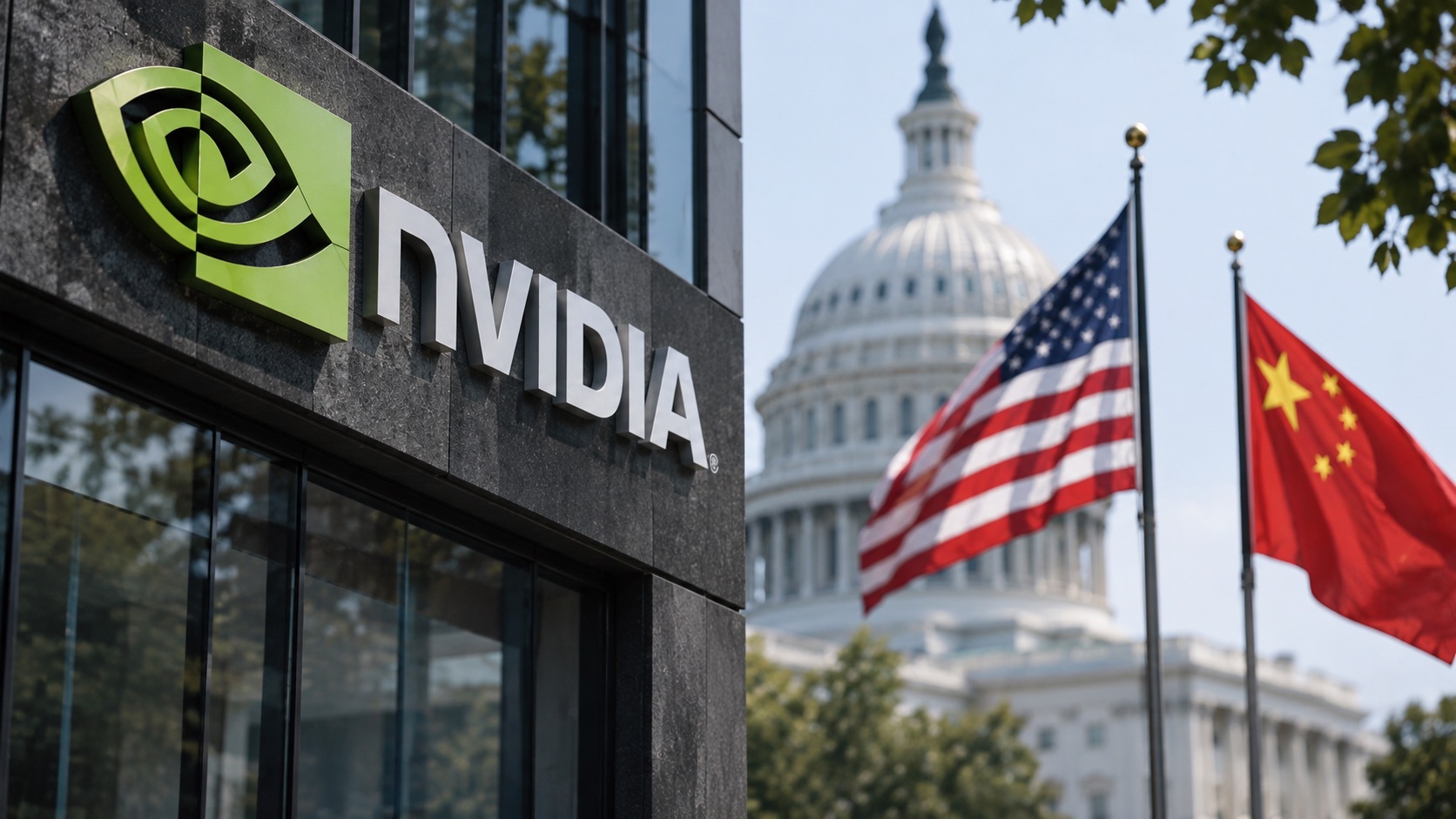
Illustration only. The photo does not show the events or allegations discussed above.