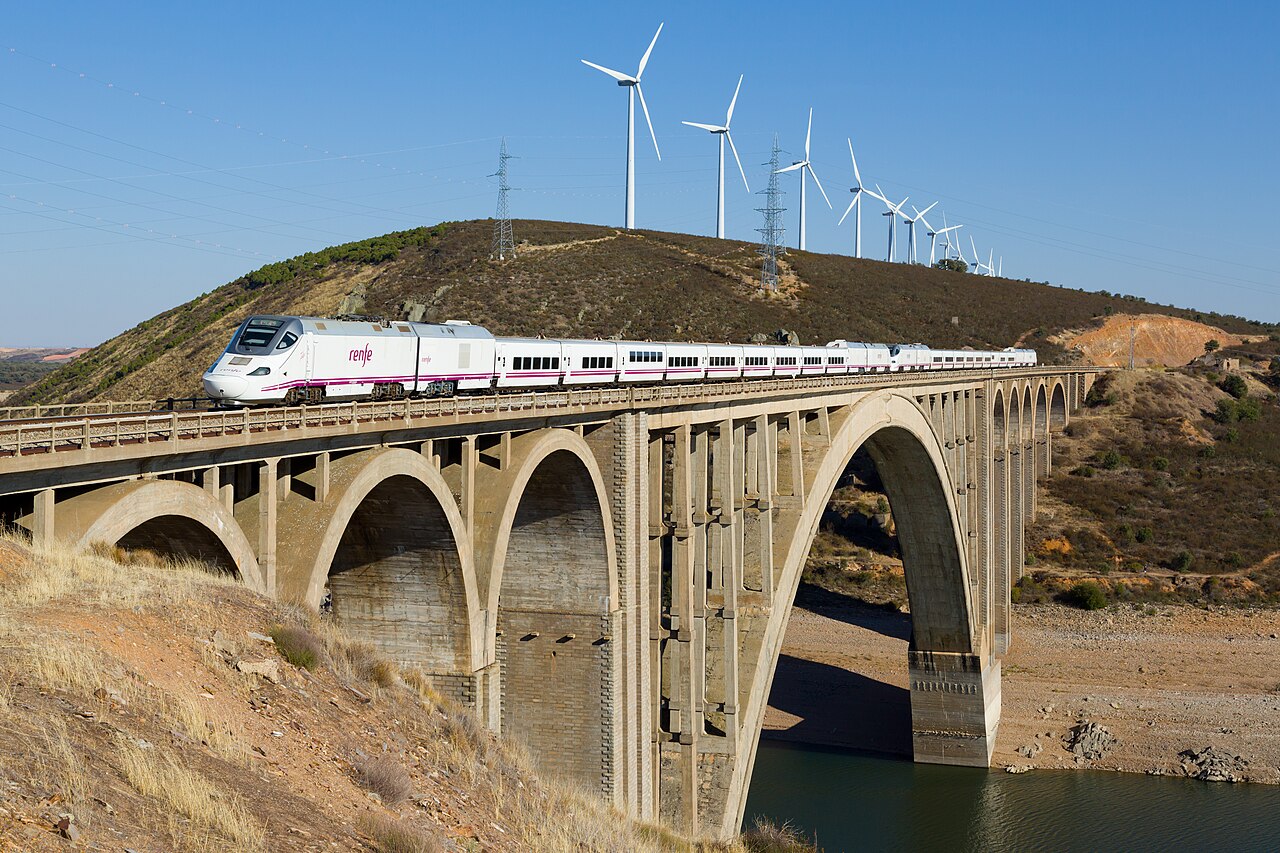

On 28 October 2026, at about 08:53, a Renfe AVE high-speed train hit a stopped Iryo train from behind near Urda, in Toledo province, on the Madrid–Seville line. The provisional toll is at least 69 dead. According to the transport minister, a failure of the LZB protection system came first, followed by an order to resume given by Adif's control centre; the technical investigation has so far established no cause. This article names no one as responsible and does not claim that an AI would have prevented the disaster. Its question is wider: if a failure and a contested decision are enough to produce a catastrophe, what place should AI have, and under what conditions?
What we know about the accident
These elements come from media and official statements consulted on 29 October 2026. The toll and the timeline may change.
The collision
The collision happened at about 08:53 (08:48 to 08:54 depending on the source), at kilometre point 118 of the Madrid–Seville line, between Mora/Orgaz and Urda. Renfe's AVE 2080, carrying 397 passengers, hit Iryo's 6076, stopped on the track, with 147 people on board according to Iryo. Several cars derailed (franceinfo, Irish Times).
The toll
Regional authorities reported at least 68 dead on 28 October, then 69 on 29 October (franceinfo). Injury figures vary by source; none is final.
The failure
At about 08:30 the automatic LZB protection system failed, from a computer or communication cause according to minister Óscar Puente; the cause is unknown. Six trains stopped over a section of 60 to 69 kilometres, and regulation passed to manual mode at Adif's network management centre in Atocha (Público, eldiario.es).
The 08:36 order
At 08:36, according to the minister, the control centre authorised the AVE to resume at "normal" speed while the Iryo was still stopped ahead of it and the protocol called for proceeding on sight at 40 km/h at most. Puente called the decision "inexplicable". Seventeen minutes separate the order from the impact, according to the times reported, and about 25 kilometres were covered. According to an audio recording published by El País and relayed by franceinfo, the Iryo driver had said at 08:48 that she could not restart because the LZB was down.
The investigations
The rail accident investigation commission (CIAF) is seized of the case; its mission is technical, it does not aim to name a culprit, and it is independent of the courts. The Guardia Civil questioned the control-centre operator and the team on shift, under the court of Orgaz. According to the minister, the person who took the decision "is under investigation"; according to Moncloa.com, no arrest or formal charge is recorded at this stage.
Europe
The European Union Agency for Railways (ERA) expressed its condolences and said it is "in close contact" with the Spanish national investigation body, following the situation with the European Commission (ERA). The Commission spokesperson said it is "too early to draw conclusions" (Agence Europe).
The context
In January 2026 an accident at Adamuz (Córdoba) killed 45 or 46 people. Regional officials say the causes of the two events appear unrelated; it is for the CIAF to say.
What the investigation must still establish
The facts: a rear-end collision, a reported LZB failure, a resume order given by the control centre.
The working hypothesis: a decision error at the control centre, combined with the failure. This is the minister's reading; the technical investigation has not confirmed it, and unions have disputed how it was put publicly.
The grey areas: the origin of the failure; whether the track-occupancy alert was blocking or merely informative; what the control centre's screen displayed; workload, training and instructions in degraded mode; the recorders; the AVE's real speed (200 km/h mentioned by the minister, 137 km/h in a reconstruction by El Español, neither value established). The minister also mentioned another train that received a similar instruction, whose driver called the control back: not confirmed.
As for a cyberattack, no official source mentions one. Rumours circulated and were noted by Maldita.es, without evidence. The hypothesis must be ruled out methodically, like any other, not by presumption.
Human error is not a sufficient explanation
If the 08:36 order was indeed wrong, the useful question is not only "who gave it" but "how could it be carried out". A well-designed safety system does not let a single error, however serious, turn into a collision. Human error is often the last visible link in a longer chain made of interfaces, procedures, workload, training and technical barriers.
To tell an individual fault from a systemic failure, one method came up in our consultation: the substitution test. Would another competent operator, with the same interface and the same instructions, have done the same thing? If so, the problem is in the system. One can also ask whether the deviation had occurred before without consequence, whether the occupancy alert could be bypassed, and whether degraded mode was trained. The two dimensions can coexist; only the investigation can decide.
Six artificial perspectives on the disaster
On 29 October 2026 we gave the same fact file to six AI models, each with a different angle. The file contained only attributed facts; the models had to stay within it and use the conditional. The answers were cross-checked against that file, and unsupported claims were removed before integration. These are prospective analyses, not facts about the accident.
| Angle | Model | Main idea |
|---|---|---|
| Critical and railway systems | GPT-5.6 Sol (OpenAI) | Defence in depth rests on several successive barriers; which one failed is unknown. |
| Human error and organisation | Claude Sonnet 5.5 (Anthropic) | "Inexplicable" is a starting point, not an inquiry result; the substitution test helps decide. |
| Supervision and detection | Gemini 3 Flash (Google) | An AI could detect the inconsistency between a stopped train and a movement order, if its sensors are independent. |
| Cybersecurity | Grok 4.3 (xAI) | Logs separate a failure from an outside intervention; no attack is established. |
| Governance and responsibility | Mistral Large (Mistral AI) | No blocking role without a named person responsible, audit and a legal framework. |
| Multi-AI architecture | Sonar Pro (Perplexity) | A closed circle only helps if its components are independent. |
The six agree on the essentials: none concludes that an AI would have prevented the accident, and all insist on independent technical locks, traceability and human accountability. They differ on dosage: some imagine an AI able to block a command, others confine it to alerts. One model also cited a national law and an equipment maker that we could not verify, so we removed them. A model that speaks with assurance is not thereby a source.
Can AI prevent the next disaster?
Yes, under conditions; no, if it is alone, opaque or attackable.
What an AI can do here is first a matter of monitoring. It could continuously cross-check train positions, section occupancy and issued orders, then flag a contradiction before an order is carried out. In the Urda case, nothing allows us to say such an alert would have changed the course of events: we do not know what the operator saw or whether an alert already existed. At most, an independent cross-check, visible at the moment of the order, could have offered one more chance to question it.
But that check is often a simple logical rule: an occupied block forbids a normal-speed movement order. It belongs to deterministic, certified, predictable locks, without machine learning. European rail safety standards (the EN 50126, 50128 and 50129 series) rest on that logic of demonstrable behaviour. AI comes as an additional layer: decision support, explanation, anomaly detection. It does not replace the foundations.
What if the system were attacked?
At this stage no official source mentions a cyberattack, and this article does not claim one. But the question deserves asking, because a signalling failure and an attack can look alike at first.
The exposure surfaces are known: ground-to-train communications, positioning, control stations, remote maintenance, logs. The model consulted on this theme points out that recorders and event logs are the only elements that can tell a failure from an outside intervention. Investigators should check their integrity, recent remote access, software updates and network anomalies, and preserve this evidence from the first hours.
An AI adds a target. Falsified input data, a poisoned model or drowned alerts can fool it. A critical AI must therefore fail safe: not rely on a single source, flag its own doubts and never be the sole guarantor of a decision. Frameworks exist for rail systems (CLC/TS 50701, IEC 62443, the NIS2 directive); applying them to AI components remains open work.
Closed-circle multi-AI: solution or illusion?
The idea is appealing: several specialised agents (perception, diagnosis, safety, audit) check one another under human supervision. It reduces the risk of a single error, on one condition: that the agents be truly independent.
That is where the reasoning weakens. If all agents read the same sensors and rest on similar models, a corrupted piece of data will produce the same error everywhere, and their agreement will give a false impression of robustness. A closed circle can also reduce outside challenge and hide a common defect.
A defensible architecture would therefore combine a simple, certified deterministic path that can always impose the restrictive state; read-only AI agents that alert and explain; separate data and suppliers; immutable logs; and a clear rule for when agents disagree, with a human to arbitrate. Diversity beats number.
Who should decide: human or machine?
The most defensible model is hybrid: the machine blocks within a strict, certified perimeter, the human understands and decides for unforeseen cases, and procedure is not negotiable. The human is at once supervisor, final decision-maker and ethical guarantor, three roles that cannot be separated.
Two symmetric risks lurk: an operator relieved of responsibility by a machine they do not understand, or flooded with alerts until they ignore them; and a machine that blocks wrongly, which also has a cost. Responsibility cannot be delegated to a model: it stays with the operator and the infrastructure manager. Before any blocking role is given to an AI, four questions need a written answer: who decides, who can override, who answers for an error, how is it audited.
What Europe should take from it
Without prejudging the investigation's conclusions, several principles emerge.
- Deterministic locks first: an order incompatible with the known occupancy of a block must be technically impossible, before it is merely discouraged by an AI.
- Independent audit of any AI component touching safety.
- Real redundancy: separate data, models and suppliers.
- Explainability: every alert or block understandable in seconds.
- Cybersecurity: immutable logs, segmentation, crisis drills in degraded mode.
- Effective human supervision: staffing, training for failures, interfaces designed with operators.
- Transparency: prompt publication of lessons, through ERA and national investigation bodies.
- A clear legal framework on responsibility, tied to the railway safety directive, the EU AI Act and NIS2.
Methodology note
The facts come from media and official statements consulted on 29 October 2026 (sources listed below). Wikipedia was used only as a starting point. Reuters, BBC, El País, El Mundo and CNN could not be read directly; their information is used only through media that cite them. No statement from the CIAF or Adif was consulted.
The six analyses were produced on 29 October 2026 by direct calls to the models, with an identical fact file and an instruction to stay within it. They are prospective and say nothing about what happened. They were cross-checked and edited: unsupported claims (legal references, equipment-maker names, unsourced technical details) were removed. The investigation is ongoing; no definitive cause is established. This article will be updated when the CIAF, Adif, the ministry or the courts publish their conclusions.
One train that stops should always be enough to stop another: that is what must be guaranteed first, before asking a machine to understand it.