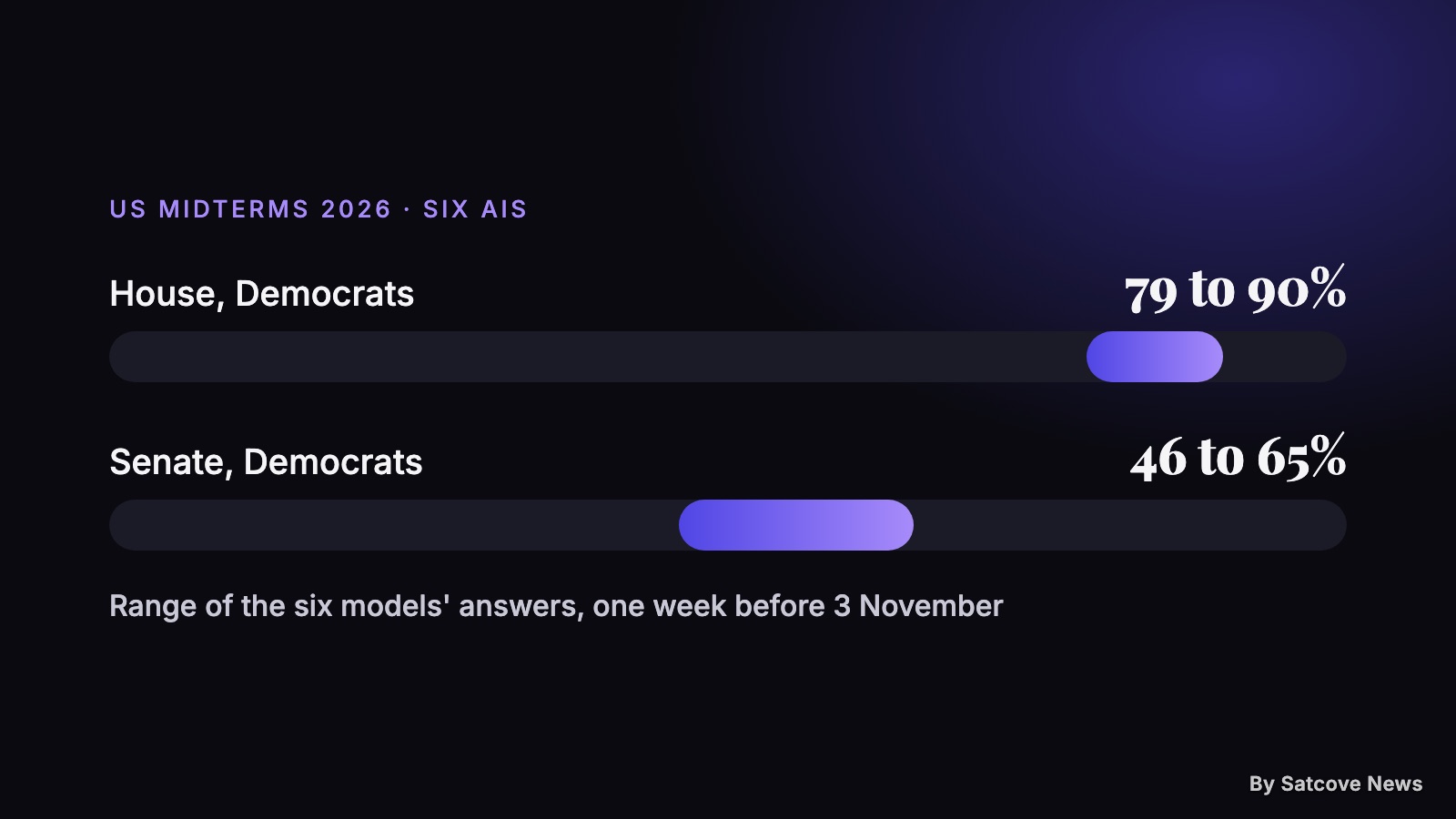
A week before the 3 November 2026 US midterm elections, Satcove asked six AI models the same question: what is the probability that Democrats win the House, and the Senate, with an uncertainty range, the three most recent sources, the assumptions, and what would change the answer. They had web search on. No betting or investment advice was allowed, and answers were capped at 250 words. This is our own research, and it describes what the AIs say. It is not a forecast by Satcove.
What each AI answered
| Model | House (D) | Range | Senate (D) | Range | Sources it named |
|---|---|---|---|---|---|
| ChatGPT | 81% | 70-90 | 50% | 30-70 | FutureBallot, Decision Desk HQ, Le Millénaire |
| Gemini | 79-83% | 70-90 | 46-56% | 40-60 | Decision Desk HQ, Polymarket/Kalshi, RealClearPolling |
| Perplexity | 80% | 70-90 | 60% | 48-72 | Decision Desk HQ, Call the Map, Silver Bulletin via The Conversation |
| Mistral | about 80% | 70-90 | 60-65% | 50-75 | Decision Desk HQ, Poliwave, Silver Bulletin |
| Grok | about 90% | 80-96 | about 65% | 55-75 | Poliwave, Silver Bulletin via The Conversation, Vote-Scope |
| Claude | 88% | 80-94 | 62% | 48-75 | Decision Desk HQ, Call the Map, Silver Bulletin, prediction markets and others |
Midpoints across the six: about 81% for the House and 60% for the Senate.
Where they agree
All six put Democrats well ahead for the House, within 79% to 90%. Every House range starts at 70% or higher. All give a range, and all are cautious in tone: none treats its figure as a certainty.
Where they split
The Senate. The spread runs from 46% to 65%. Democrats need a net gain of four seats against a 53-47 Republican majority, so small shifts in a few close races move the odds a lot. The AIs mostly relay published models, and those disagree. In Claude's reading, Decision Desk HQ gave 56% for the Senate, Call the Map 55%, Silver Bulletin 75% and On Point Politics 78%. None of the AIs took the top of that range. The AI spread therefore mirrors the spread among published forecasts, and sits at its lower half.
How much they explain. ChatGPT's 50% for the Senate is a synthesis with no model of its own. Gemini gave no assumptions, though the question asked for them.
What would change their minds. Claude names a generic-ballot lead under 5 points, a systematic polling error in favour of Democrats, and swings in close Senate races such as Texas, Ohio, Iowa and North Carolina. We have not compared the other five answers on this point.
What we could verify
We opened two of the sources the AIs named.
- Poliwave (run of 26 October, 100,000 simulations): Democrats have 87% to win the House (median 230 seats) and 57% for the Senate, with a 32% chance for Republicans and an 11% chance that independents decide control. The site says the model has not been calibrated against past elections. Grok, which cited Poliwave, gave about 65% for the Senate, above Poliwave's own 57%.
- Vote-Scope (updated 25 October): Democrats have a 71% chance of winning the Senate, which matches the figure Mistral reported.
Not verified: FutureBallot and Le Millénaire, both cited by ChatGPT, whose Senate figures differ widely (62-69% and 30.9%), and Mistral's mention of an unpopular war with Iran as an assumption. Treat them as unconfirmed.
What this says about the AIs
The answers are not independent. Decision Desk HQ appears in five of the six, and Silver Bulletin in four. An AI that cites a forecast does not add information to it, and a spread among AIs mostly reflects a spread among sources. Claude also answered after reading the other five, which can anchor its numbers.
Limits
- One attempt per model, no fixed temperature, and different tools and modes between providers.
- Prediction-market prices that Claude used dated from 15 October.
- We did not read every source page one by one.
- Poliwave's own model is not calibrated historically, and a probability cannot be judged on a single election.
What comes next
The election is on 3 November. We will compare each number with the result and update this page. If we repeat the exercise, we will keep a score such as the Brier score for each model. To put your own question to several AIs at once, try Satcove Open.