Short answer. There is no honest "most trustworthy" among Claude, ChatGPT and Gemini. On the one public benchmark that measures made-up content in summaries, the spread inside one brand is larger than the gap between brands. Pick by the model version and the task, and verify anything you will act on. Data read on 2026-10-26.
Is Claude more trustworthy than Gemini or ChatGPT?
Nobody can say that in general. Trust depends on the model version, the task, and whether the answer can be checked. The best public evidence we found measures one narrow thing: how often a model adds information that is not in a document it was asked to summarise.
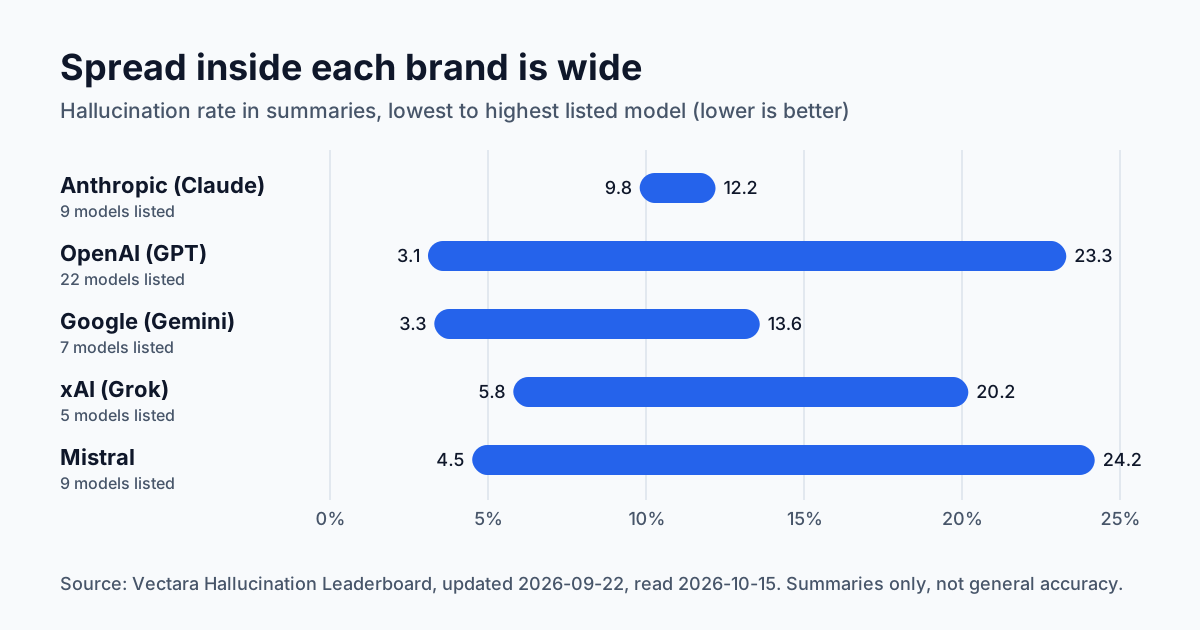
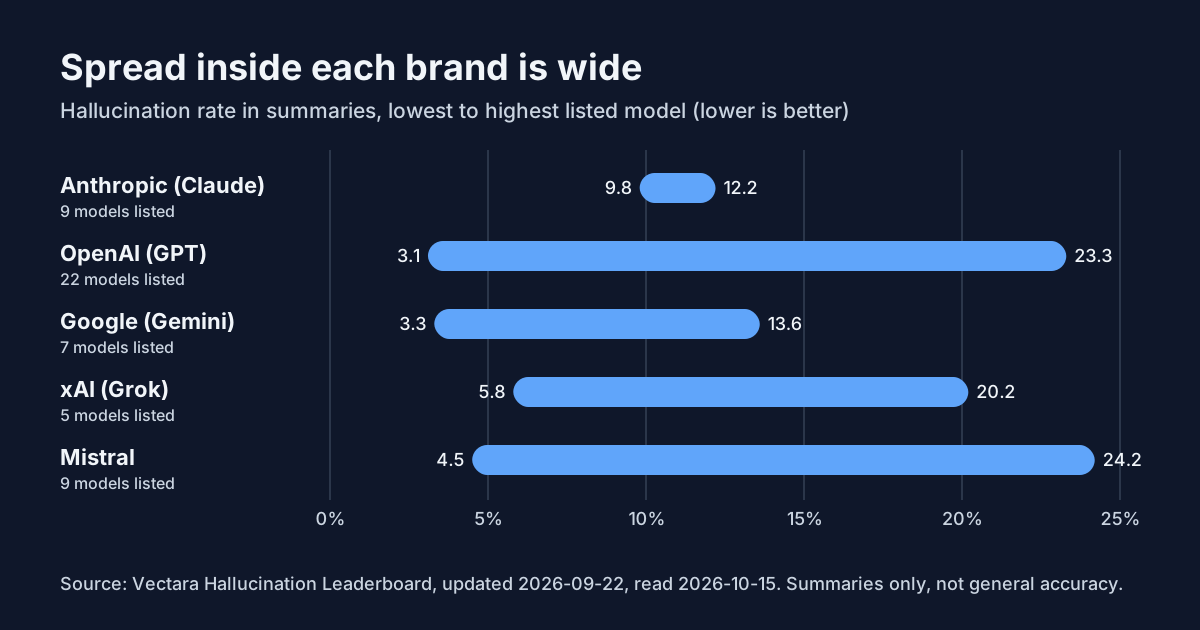
The Vectara Hallucination Leaderboard (updated 2026-10-22, 111 models) gives these ranges for the providers we track:
Source: github.com/vectara/hallucination-leaderboard. Lower is better. Our compilation, with every row, is on the AI hallucination benchmarks page.
What does this benchmark tell you, and what does it not?
It tells you that two models from the same company can sit far apart: OpenAI's listed models range from 3.1% to 23.3%. Choosing "ChatGPT" or "Gemini" as a brand tells you little. The version matters.
It does not tell you which assistant is right more often when you ask an open question. It tests faithfulness to a supplied text, in summaries. It says nothing about maths, law, medicine or recent events. Treat it as one signal, not a ranking of overall truthfulness. We do not publish a Satcove ranking of models.
Why do the three disagree on the same question?
Four usual causes: a different reading of the question, a different knowledge cutoff, a genuinely open topic, or one model inventing a detail. The first three are normal. The fourth is the risk. Our guide on what to do when ChatGPT, Claude and Gemini disagree gives a five-step routine, also in this blog guide.
What does each assistant do that the others do not?
Keep this practical rather than tribal:
- Claude lists Projects and Claude Code in its paid plans (claude.com/pricing, read 2026-10-18).
- ChatGPT has Go, Plus and Pro tiers on chatgpt.com/pricing (read 2026-10-18); check that page for what each tier includes.
- Gemini paid plans (Google AI Plus, Pro, Ultra) bundle more model access with 400 GB to 20 TB of Google storage (gemini.google/subscriptions, read 2026-10-15).
These are plan features taken from vendor pages, not claims about who is more accurate. For current prices see the subscription prices page.
How do you decide, then?
- Match the model to the task. Summarising a document you supply is where the benchmark above applies. Open questions need a different check.
- Make the claim checkable. Ask for sources, then open them. A confident answer with no source is a lead, not a fact.
- Compare two or three answers on anything important. Agreement raises your confidence a little. Disagreement tells you exactly which claim to verify. Agreement is still not proof, because models can be trained on overlapping data.
- Go to a primary source for money, health, legal or safety decisions.
Where does a multi-model tool fit?
Satcove sends one question to six models and shows where they agree and where they split, with an agreement score. It does not make the answer true and we never claim it does. It saves you the copy-paste step of the routine above. Single-vendor apps remain better for deep, long sessions inside one ecosystem.
In Satcove. Ask once and see where the models agree and where they split, then open Verify to check which claims have evidence behind them. Our own tests and method are on the benchmark page. Agreement raises confidence a little; it is not proof.
FAQ
Which AI hallucinates the least? On Vectara's summary benchmark, the lowest rates belong to models from several different providers, and each provider also has models with much higher rates. See the table above and check the leaderboard for the current order.
Is the newest model always safer? Not necessarily. On the leaderboard, newer versions of a brand do not always score better than older ones. Look at the specific model.
Can I trust an AI that cites sources? Only after you open the source. Models can cite pages that do not support the claim, or that do not exist.
Benchmark figures read from the Vectara leaderboard on 2026-10-26. Rates change with each update.