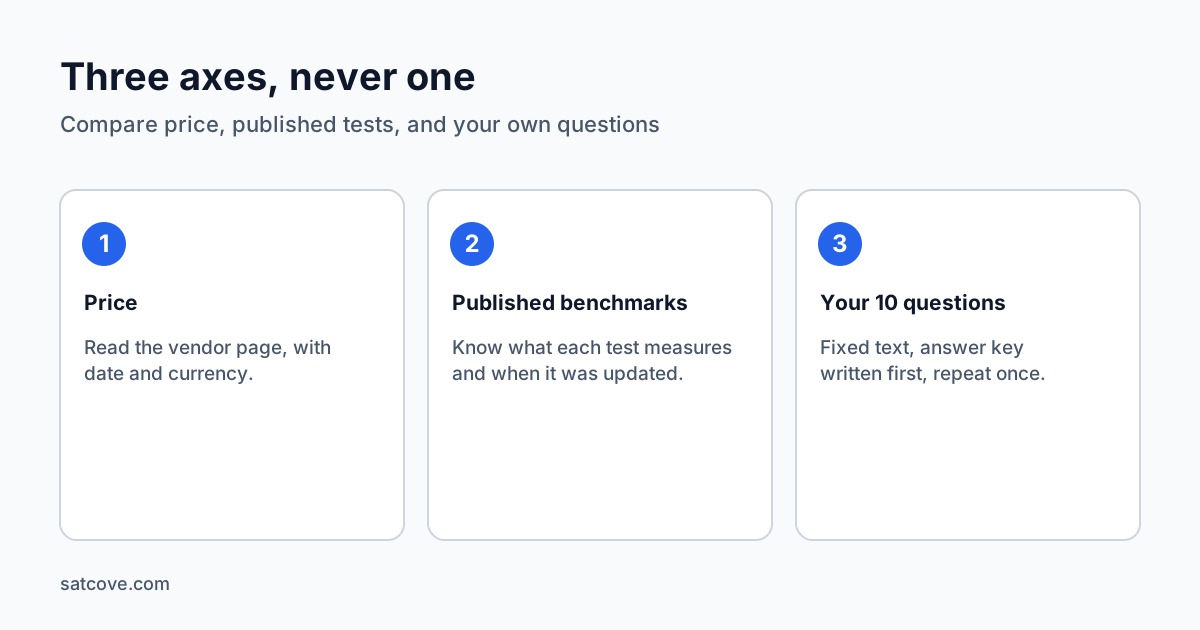
Short answer. Compare on three separate axes, never one: what it costs (vendor price pages), how it behaves on published tests (benchmarks, read with their limits), and how it does on your own 10 real questions. A single "best model" score hides all three. Sources and dates below, read on 2026-10-18.
Why is there no single "best" AI model?
Models trade off cost, speed, accuracy on a given task, usage limits and features. A model that is cheap and fast can be worse on hard reasoning. One that scores low on a summary test can be strong at writing. Any site that gives you one number for "best" is hiding that trade-off, ours included, which is why we publish no overall ranking.
Axis 1: how do you compare prices?
Go to the vendor page, not a review. Prices differ by billing period, currency and tax, and they change.
We keep the dated figures on the AI subscription prices page. Compare the same thing each time: monthly price, annual price, and what the usage limit is.
Axis 2: how do you read benchmarks?
Benchmarks answer narrow questions. Before you use one, ask what it measures, on what data, and how recent it is.
- Vectara Hallucination Leaderboard measures how often a model adds unsupported information when summarising a text. It does not measure general accuracy.
- Artificial Analysis Omniscience measures general knowledge reliability: it rewards correct answers, penalises wrong ones and does not penalise refusals.
- FACTS Grounding tests whether answers stay grounded in a supplied document. We have not yet included it because we could not read it.
Our benchmarks page compiles what we could read, with dates and a CC BY 4.0 download. Two cautions: benchmark authors can tune their own tests, and a model's score changes with each version, so read the row for the exact model you plan to use.
Axis 3: how do you test models on your own questions?
This is the one that matters most and the one people skip.
- Write 10 real questions from your work. Mix easy ones, ones with a checkable answer, and one or two you know are tricky.
- Fix the question text. Same words for every model.
- Decide the answer key first from a primary source, before you look at any output.
- Score each answer: correct, partly correct, wrong, or refused. Note any invented citation.
- Repeat once on a different day. If results shift, the difference is noise.
Ten questions will not prove a model better, but they will show you which one fits your work and where each one fails.
Is there a tool that compares models side by side?
Yes, several. Chat apps that let you send one prompt to multiple models are the quickest way to run step 3 above. Satcove does this with six models and adds an agreement score, so you see which answers align and which split. Other tools in this space include MultipleChat and Mammouth; each has different limits and features, and some are better for long single-model work. Use the one that matches your test, and read each tool's own pricing page.
What should you not do?
- Do not trust a "best AI" list without a date and method.
- Do not compare a free tier of one assistant with a paid plan of another.
- Do not pick on tone. A fluent answer is not a correct one.
- Do not treat agreement between models as proof. See whether consensus proves truth.
In Satcove. Run your 10 questions as a Cove Fight to see opposing cases side by side, or ask once and compare six answers with an agreement score. Our benchmark page shows how we test and what it cannot tell you.
FAQ
What is the best AI comparison tool? It depends on your test: a side-by-side chat for quick checks, a benchmark page for published data, a spreadsheet for your own question set. Use all three for a decision that costs money.
How often should I redo a comparison? Every few months, or when a vendor ships a major model. Versions change fast.
Can I compare AI models for free? Yes. The free tiers of most assistants are enough to run a 10-question test.
Sources read on 2026-10-18. Prices and scores change; verify before you rely on them.