Short answer. You usually cannot tell from the tone: wrong answers sound as sure as right ones. Check the specific claims you will act on (names, numbers, dates, quotes, citations) against a primary source, ask a second assistant to challenge the answer, and rewrite your question with more context. Never treat an AI's own "I am sure" as evidence. For the full method, see our guide to verifying AI answers.
How do I know if ChatGPT (or any AI) is hallucinating?
Watch for these six signs. None proves an error; together they tell you where to look.
- A very precise detail with no source. An exact figure, quote or date that you cannot trace.
- A citation you cannot find. The paper, case or URL does not exist, or does not say what is claimed.
- Names and titles that look right but are slightly off. Plausible author, wrong journal; real law, wrong article number.
- Different answers when you ask twice. If the same question gives different facts, at least one is invented.
- Agreement with your wrong premise. Models tend to go along with the question as framed. See why AI agrees with you.
- Recent events. Anything after the model's knowledge cutoff is a guess unless it searched the web.
How common are wrong answers?
It depends on the task and the model. One public measure is Vectara's leaderboard of how often models add unsupported information when summarising a supplied text. On its 2026-10-16 update, rates for the 109 listed models run from 1.8% at the lowest, and the models from the providers we track range from 3.1% to 24.2%. That is a narrow test, summaries only, so it understates the risk on open questions where no source text is given. Details and every row are on our hallucination benchmarks page.
What should I do when an answer looks wrong?
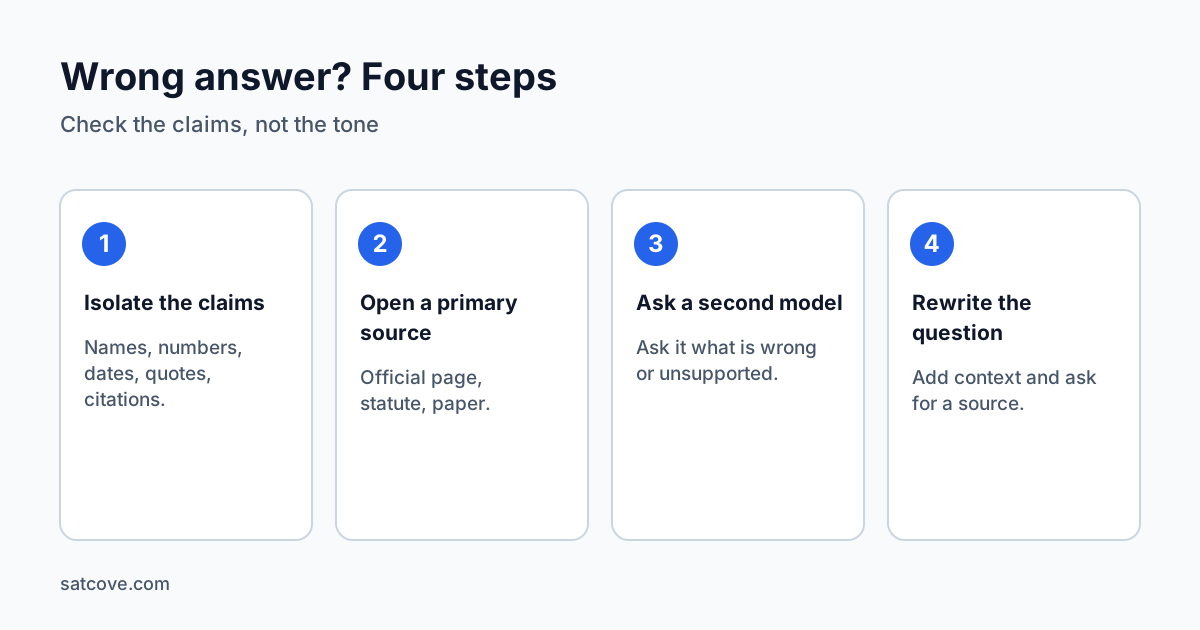
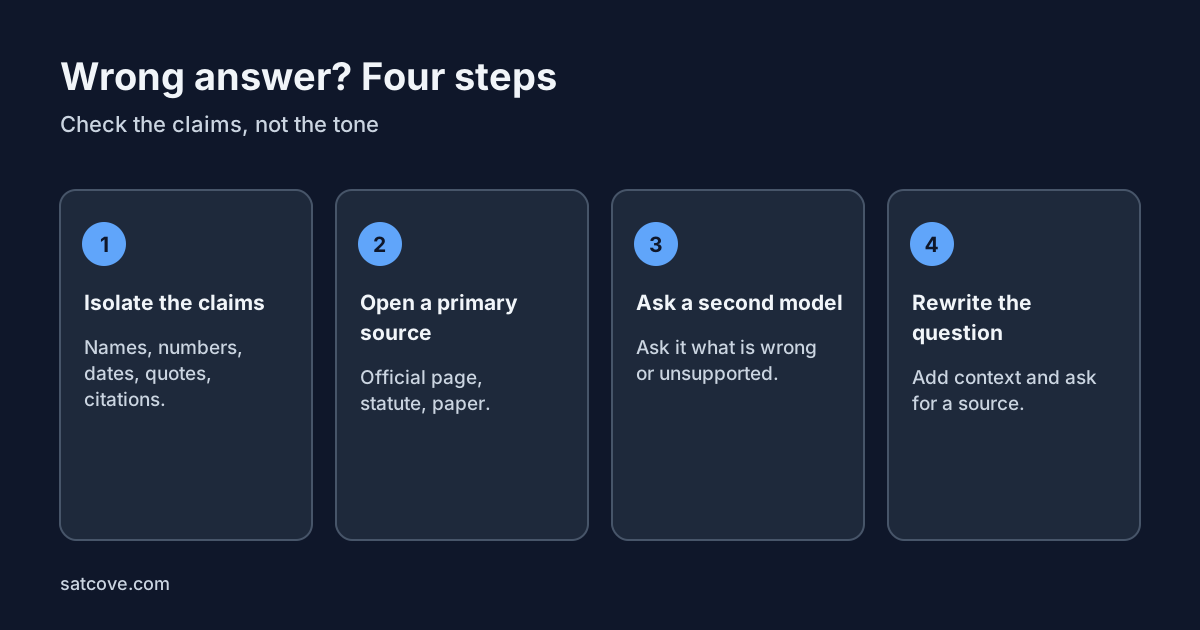
1. Isolate the claims
Copy out the specific facts: names, numbers, dates, quotes, citations. Ignore the style. You only need to check what you will rely on.
2. Open a primary source
Official site, statute, paper, manufacturer page. Two minutes is usually enough for one claim. If you cannot find support, treat the claim as unsupported.
3. Ask a second assistant to challenge it
Paste the question and the answer into another assistant and ask: "What here is wrong or unsupported? What would you change?" This often exposes the weak point. It is not a verdict, because assistants tend to agree with what they are shown, so use it to decide what to verify in step 2.
4. Rewrite the question
Add what was missing: country, date, your exact situation, and the instruction "say you are not sure if you do not know" and "give a source I can open". Then compare the new answer with the old one.
How should I check each kind of claim?
If a claim fails the check, say so to the assistant and ask it to correct it. See also fake legal citations for a high-stakes case.
What can I paste to challenge an answer?
Use these templates as they are. They ask for checkable output rather than reassurance.
- Challenge: "Here is a question and an answer. List every factual claim in the answer, mark each as well supported, uncertain or unsupported, and say what you would change. Do not agree out of politeness."
- Source request: "For each claim, give a source I can open. If you cannot, say you are not sure instead of guessing."
- Rewrite: "Answer again for [country] as of [date]. If the answer depends on something you do not know, ask me first."
What does a wrong answer look like?
This is a constructed example to show the pattern, not a real model output. You ask for the year a law came into force and get a confident sentence with an exact date and an article number. Everything reads well. You search the official gazette and find that the article number belongs to a different law, and the date is a year off. The model produced a plausible, specific, wrong detail. Specific and fluent is exactly when to check.
Why does my AI keep giving wrong answers?
Common reasons: the question is vague, the topic is after the knowledge cutoff, the model has no access to the file or page you mean, or the task needs exact recall (citations, statistics, obscure facts) where models are weakest. Fixing the question removes the first three. For the fourth, add a source yourself and ask for an answer based only on it.
Can ChatGPT fact-check?
It can help you find claims worth checking and suggest where to look. It cannot be the final checker of its own output. For a stronger check, compare several models and open the sources. Satcove automates the comparison: it asks six models and shows where they split. That tells you which claim to verify; it does not prove an answer true.
When should I stop and ask a human?
If a wrong answer could cost you money, health, legal standing or safety, use the AI to prepare your questions and then ask a qualified professional. Do not rely on any assistant, including a multi-model one, for those decisions.
In Satcove. Paste a claim, a link or a forwarded message into the Verify tool: six models answer in parallel and the disagreement is shown, no sign-up. For a suspicious image, use Is this AI?. These point you to what to verify; they do not replace the primary source.
FAQ
Is it my fault if the AI is wrong? Sometimes a vague question causes it, but often not. Models can be wrong on clear questions too.
Does asking "are you sure?" help? Little. The model may flip its answer or defend it with the same confidence. Ask for sources and open them instead.
Do paid models hallucinate less? Not reliably. Newer or bigger models are not always better on measured hallucination. Check the specific model on a benchmark and verify what matters.
Benchmark figures read from the Vectara leaderboard on 2026-10-18.