Quick answer: An AI aggregator runs your question through multiple models and shows the raw answers side by side — you compare and pick. A consensus engine runs the same question through multiple models, synthesizes the answers into one verdict, and surfaces an explicit agreement score. Aggregators are tools for comparison; consensus engines are tools for decisions. They look similar on a pricing page and behave very differently in daily use.
The One-Line Distinction
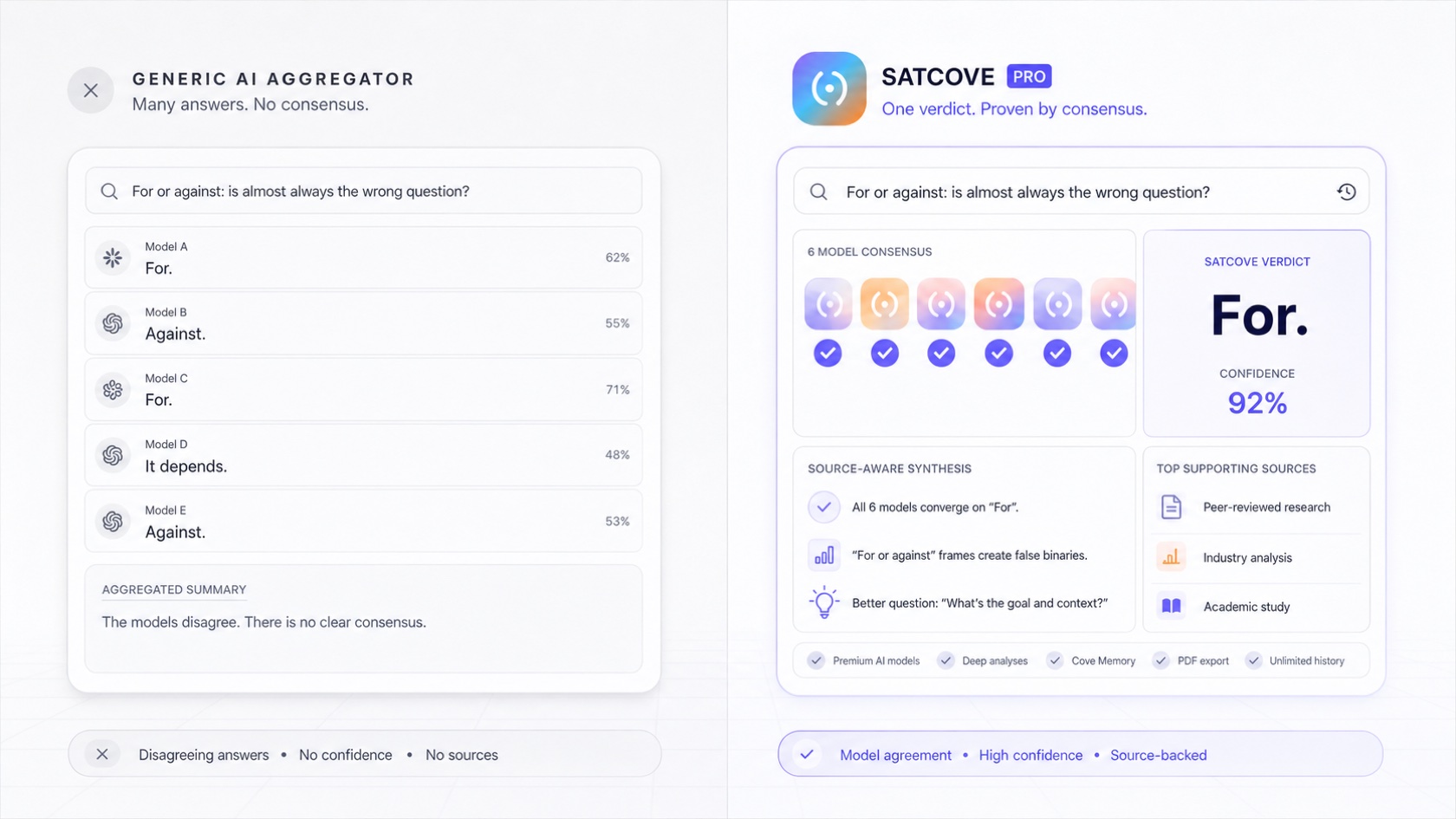
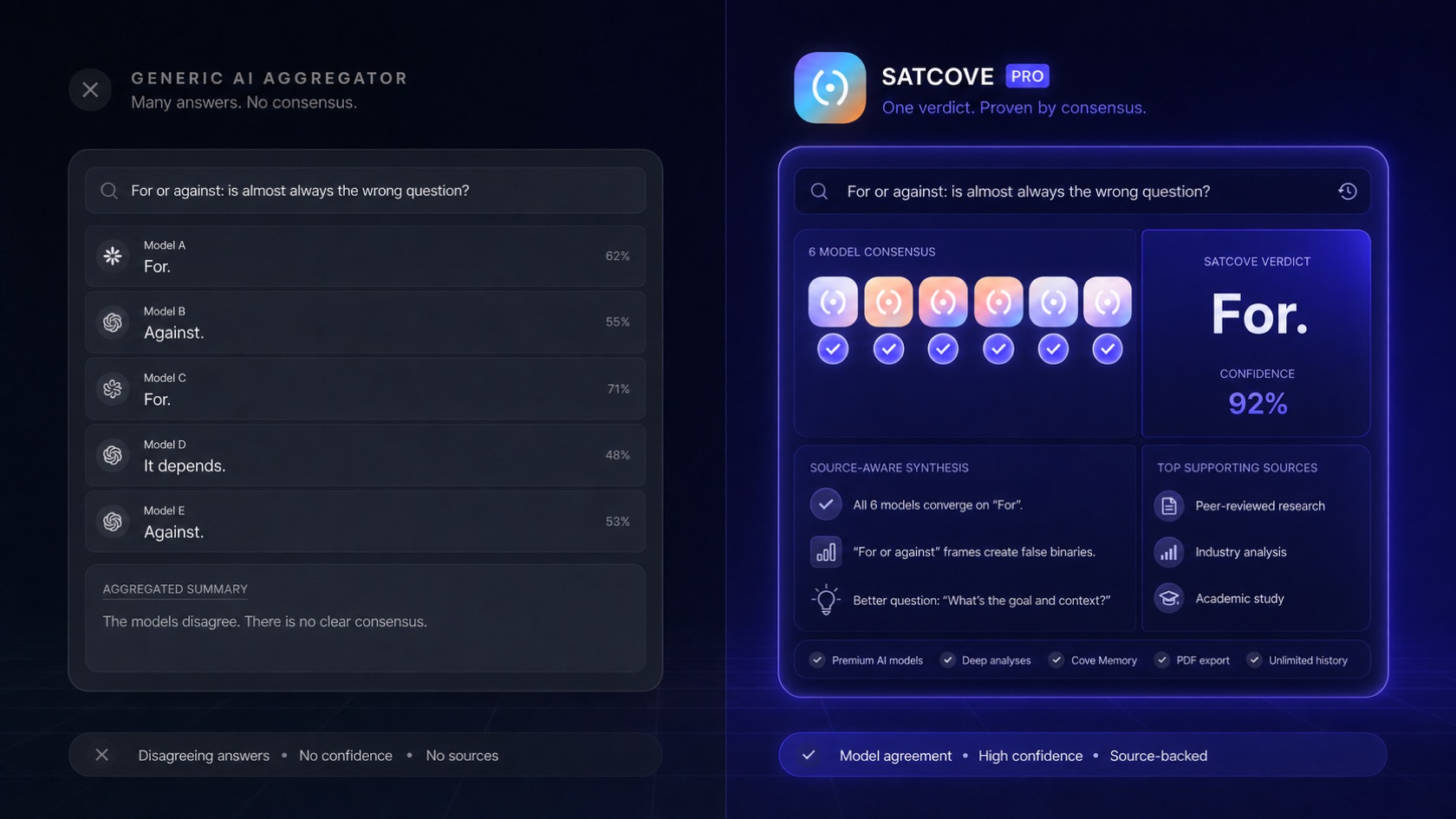
Aggregator output: six raw answers, you do the synthesis yourself.
Consensus engine output: one synthesized answer plus an agreement score, the synthesis has been done for you.
Most users discover the distinction only after using both. The pricing page makes them look the same — "multi-AI access for under $20/mo." The daily-use experience is structurally different.
What Aggregators Do Well
Aggregators preserve the raw model voice. When you read GPT's answer next to Claude's next to Gemini's, you see each model's reasoning style, each model's confidence calibration, each model's blind spots. That visibility is useful in some contexts:
- Comparing how different models approach the same question. Researchers, AI educators, prompt engineers benefit from this directly.
- Spotting which model is best for a specific task type. After enough side-by-side comparisons you build intuition for "Claude wins on long-form, Perplexity wins on web-current questions."
- Maintaining manual control over which answer you trust. Some users explicitly want the comparison step and would not delegate it to a synthesis layer.
The cost of this visibility is the comparison work itself. You read six answers, you decide which one to trust, you copy the relevant parts into wherever you are working. On every question.
Tools in this category: AI Fiesta, ChatHub, MultipleChat. See the full multi-AI comparison for details.
What Consensus Engines Do Well
Consensus engines do the comparison and synthesis for you. The output surface is one verdict with an explicit agreement score. The raw per-model responses are still available if you want to inspect them, but the default view is the synthesized answer.
The value shows up in contexts where:
- You want a decision, not a comparison. Health, legal, financial, technical decisions where you are about to act.
- You want a confidence signal you can read at a glance. The agreement score is a single number — 80% means "strong consensus," 40% means "real disagreement, dig deeper." A user who sees this once does not want to go back to "read six answers and figure it out."
- You are time-constrained. A consensus query is 8–15 seconds. Reading and comparing six full responses is several minutes.
Tools in this category: Satcove (consumer-grade), Tryverdict (early-stage), ConsensusEngine.io (research-oriented).
A Concrete Example
Same question, two surfaces:
"Can a French PEL savings account be transferred to an heir after the owner's death?"
Aggregator output (paraphrased):
GPT:    Yes — under certain conditions, with unanimous heir agreement.
Claude: No — the PEL is closed on death. Balance enters the estate.
Gemini: Yes — transfer is recognized under French banking law.
Mistral: No — the account is closed upon death.
Perplexity: Mixed — some sources say transfer is possible.
Grok: Probably no — standard interpretation is closure.
The user reads six answers, three of them contradicting the others, and has to decide which to trust. The decision often defaults to whichever answer sounds most authoritative — usually a heuristic, not a verification.
Consensus engine output (same question):
Verdict: No — the PEL is closed upon the account holder's death and
the balance enters the estate. There is no legal provision under
French banking law for transfer to an heir.

Agreement score: 30%

Divergence noted: GPT and Gemini provided answers describing a
transfer mechanism that does not exist under the current statutory
framework. Claude, Mistral, and Grok converged on the correct
interpretation. The 30% score reflects this substantive split.

Recommendation: Confirm with a notaire before acting. The
disagreement here is not stylistic — it reflects one position being
factually wrong.
Same six models. Same six raw answers underneath. Different output surface. The aggregator preserves the contradictions; the consensus engine surfaces the contradictions and tells you which side of the split has the weight of evidence.
This is the case study from the AI factual accuracy benchmark.
When the Aggregator Wins
Consensus engines are not always the right pick. There are use cases where the aggregator approach is structurally better:
- You are running model comparisons as your job. Prompt engineers, AI researchers, evaluators — you specifically want the raw model voice visible.
- The synthesis step adds latency you cannot afford. A consensus query is 8–15 seconds. An aggregator can stream the raw answers as they come in.
- You distrust synthesis steps philosophically. Some users (often power users, often correctly) believe that any synthesis introduces editorial bias by the synthesis model. They would rather see raw outputs and synthesize themselves.
In each of these cases, an aggregator is the better tool. The choice is not "consensus engine is always better" — it is "different tools for different jobs."
For a broader tool-selection checklist, read when not to use multi-AI consensus.
When the Consensus Engine Wins
The consensus engine wins by default for the typical user:
- You ask AI questions to inform decisions. You are not running comparisons for their own sake.
- You value an explicit confidence signal. Knowing whether an answer is consensus-strong or genuinely contested is more useful than reading six versions of it.
- You use AI on mobile or in passing. Reading six raw answers on an iPhone is not a great experience. One verdict with an agreement score is.
- You have a high cost of being wrong. Medical, legal, financial, technical. The cross-validation is doing real work for you.
For most consumer AI use in 2026, this is the typical user. The aggregator category is positioned for the power user; the consensus engine category is positioned for everyone else.
The Price Gap Is Misleading
Aggregators tend to be a few dollars cheaper than consensus engines: AI Fiesta at $12/mo, ChatHub at $14.99/mo, Satcove at €14.99/mo. The gap looks small.
The gap pays for the synthesis layer (a synthesis model running on top of the six provider calls), the agreement scoring, the iOS app, and the vertical features (debate mode, photo verification, privacy shield). When you do the math on the daily comparison work an aggregator pushes onto you, the few dollars stop looking like a meaningful saving.
The honest framing: you pay slightly more for a consensus engine and you get back several minutes per day of comparison work, plus a confidence signal that reduces decision errors. The ROI is essentially always positive if you use AI more than once a day.
What About Routers?
Routers — the third category — pick one model per task on your behalf. They feel cheap and fast: only one API call per query, no synthesis overhead. But the trade-off is severe: you get one answer chosen by an algorithm, and you are back to single-model failure mode. The model the router picked could be confidently wrong, and you would not know.
Routers can be useful for cost-sensitive applications at scale (production workloads, embedded AI features). For consumer decision-making, they are the worst of the three categories — you pay for multi-AI access and only ever see one answer.
How to Pick
The decision tree:
- Are you running model comparisons as part of your job? → Aggregator.
- Are you on a tight cost budget at production scale? → Router.
- Anything else? → Consensus engine.
Most users default to category 3. The aggregator and router categories exist for legitimate edge cases. They are not the right primary tool for the typical user trying to replace six separate consumer AI subscriptions.
Try a Consensus Engine Free
Satcove's free tier gives eligible new accounts three consensus runs per week. Pick a question you have asked AI before and got a single answer for. Run it through a consensus engine, then inspect the agreement score and the unresolved points.
Or read the comparison of seven multi-AI subscriptions for the full landscape.
This article uses the case study from the AI factual accuracy benchmark and reflects public information about each tool as of mid-2026.