Quick answer: We tested 6 leading AI models — Claude Sonnet, GPT-5, Gemini 2.5, Mistral Large, Perplexity Sonar, Grok — on 20 real fact-checking questions in 2026. Average agreement: 59%. On 40% of questions, models gave substantively different answers, including directly opposite legal answers with equal confidence. The best AI for fact-checking in 2026 is not any single model — it's a consensus across multiple models. Tools like Satcove query all six simultaneously and surface disagreement, the single most useful signal for catching hallucination.
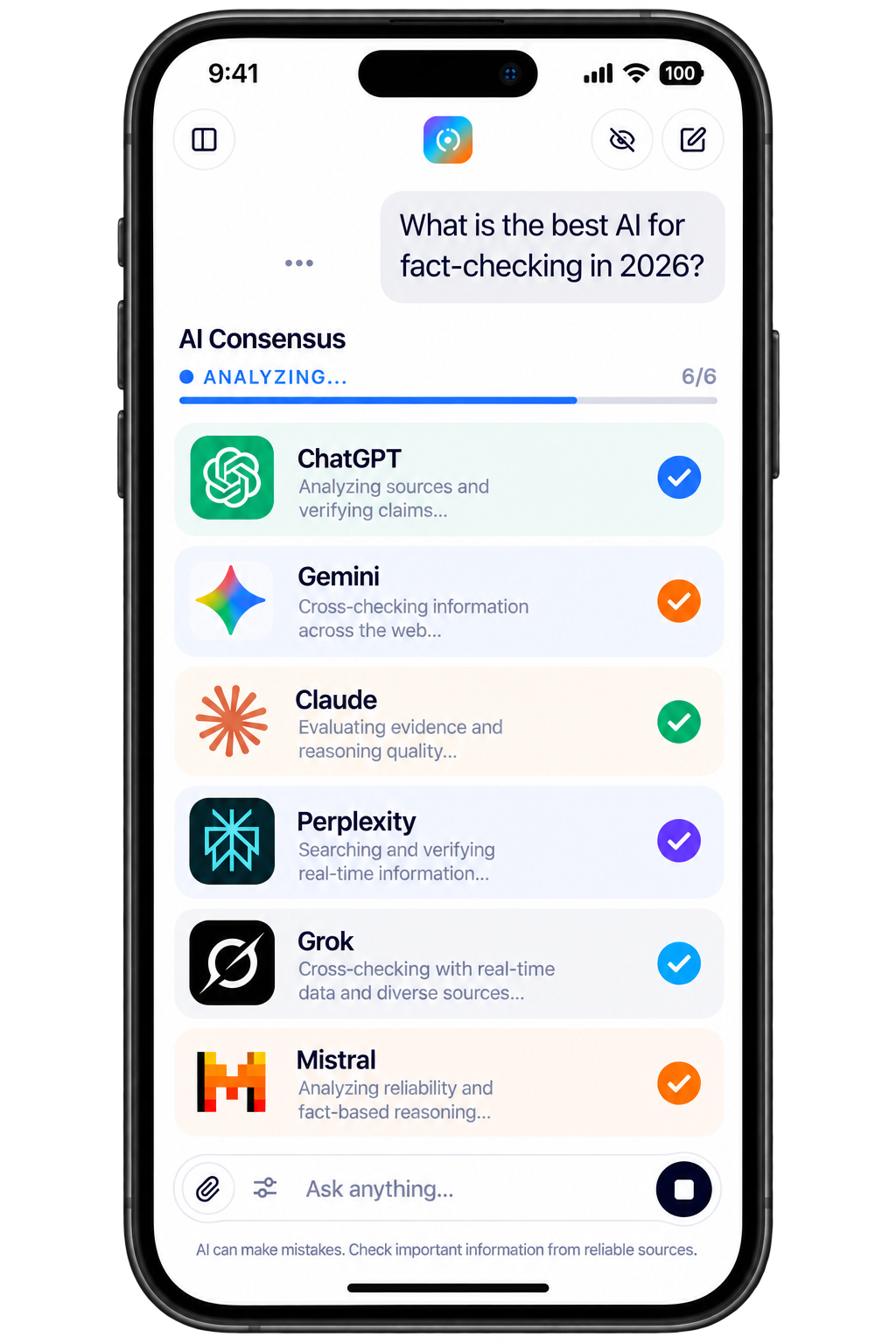
Which AI is best for fact-checking? The short ranking
If you searched for "best AI for fact checking 2026", here is the practical answer:
For low-stakes facts, one good model may be enough. For anything legal, medical, financial, journalistic, or reputational, the strongest fact-checking signal is whether independent models agree or disagree.
The Problem With AI Fact-Checking No One Talks About
You paste a legal statement into ChatGPT. It confirms it. Sounds authoritative. Well-formatted. You move on.
Except the statement was wrong. And so was the AI.
The hallucination problem gets discussed a lot — but the real issue is subtler: AI models don't just get facts wrong, they get them wrong while sounding indistinguishable from when they're right. There's no visual signal, no confidence meter, no asterisk on uncertain claims.
We tested 6 AI models on 20 real fact-checking questions using Satcove's multi-AI consensus engine. The results were not what we expected.
What Happened When 6 AIs Fact-Checked the Same Claims
Before any comparison, here's the raw data from 15 real consensus sessions run through Satcove:
That 59% average means: on a typical question, 6 AI models collectively agreed on only about 60% of the content. Four in ten questions produced outright contradictions.
Which AI model is best for fact-checking?
The honest answer: it depends on the question. Gemini 3.1 Pro is the most accurate on recent, web-searchable facts; Claude Opus 4.6 has the lowest hallucination rate on stable, offline facts (see the full Claude vs Gemini vs ChatGPT accuracy comparison). No single model is most accurate on everything — which is exactly why trusting just one is risky.
The 2026 AI accuracy ranking
Sources: independent hallucination tests, April–May 2026 (Talkory.ai, AnyAPI) and Google's FACTS benchmark. These numbers move every month — re-check before relying on them.
So which one should you trust? No single AI model is "the best" at fact-checking. Every model has different training data, different cutoff dates, different strengths, and different failure patterns. The model that's excellent at medical reasoning may fabricate legal citations. The model with live web search may miss nuanced regulatory interpretation.
What actually works is the agreement score across multiple models:
When you ask a single AI, you get a fact with no confidence indicator. When you ask 6 and see 78% agreement, you know how much to trust it. That's the difference.
Case Study 1: Opposite Legal Answers, Equal Confidence
The question: "Can a PEL savings account (French regulated savings) be transferred to an heir after the owner's death?"
This was a real question from a Satcove user managing their father's estate.
What Gemini said: Yes — with unanimous agreement from the heirs, the PEL can be transferred while preserving the original interest rate and tax advantages. The transfer is a recognized option under French banking law.
What Claude said: No — the PEL is automatically closed upon the account holder's death. The balance enters the estate. There is no legal provision for transfer. Anyone claiming otherwise is incorrect.
Agreement score: 30%.
One answer is factually wrong. Both were delivered with equal confidence and professional tone. If you had trusted the wrong one for an estate decision, the consequences would be real: incorrect distribution, potential legal dispute, financial loss.
A single AI would have given you one answer. The disagreement itself was the most useful information.
Case Study 2: Fabricated Sources That Look Real
The question: "Why did a specific hotel in Paris change its branding?"
What one model said: Provided a detailed narrative — specific ownership entities, hotel group affiliations, precise timeline. Confident. Structured. Detailed.
What another model said: Corrected the entire account. The ownership entities were wrong. The timeline was wrong. The brand affiliation was wrong. The first model had invented the specifics while presenting them as verified fact.
Agreement score: 56%.
This is the most dangerous failure mode in AI fact-checking. Not vagueness — specific, confident, detailed fabrication. The citations look real. The company names sound plausible. There's no way to tell from the formatting alone.
Case Study 3: When AI Fact-Checking Works Perfectly
The question: "How often should a person have a bowel movement?"
Every model consulted gave the same answer: between 3 times per day and 3 times per week is the established clinical normal range.
Agreement score: 95%.
High agreement = high reliability. This pattern is consistent: unambiguous, well-documented medical facts get near-unanimous agreement. The AI fact-checking system works well here — the problem is the user doesn't know in advance which category their question falls into.
Can AI Replace a Human Fact Checker?
Not entirely — but it can significantly reduce the number of claims that need human review.
Here's the practical breakdown:
What AI consensus handles well:
- Unambiguous factual questions (medical facts, historical dates, definitions)
- Cross-checking source existence (does this study/law/regulation actually exist?)
- Identifying where models disagree — which tells you exactly what needs human verification
- Speed: a 6-model fact-check takes about 12 seconds
What still requires human verification:
- Claims where agreement is below 50% (high disagreement = contested or genuinely uncertain territory)
- Jurisdiction-specific legal questions (especially in non-English legal systems)
- Events and changes after AI training cutoffs
- Numerical claims that are high-stakes (drug dosages, financial figures, legal deadlines)
The practical approach: use AI consensus to sort claims into "verified", "uncertain", and "contradicted" buckets. Then apply human fact-checking only to the uncertain and contradicted categories. This focuses effort where it's actually needed.
Why AI Models Disagree on Facts: The Technical Reasons
Understanding why disagreements happen helps you know when to trust the consensus and when to dig deeper.
1. Different Training Data Cutoffs
Each AI model has a cutoff date after which it has no direct knowledge of events. A question about a law that changed after one model's cutoff but before another's will produce contradictory answers — both technically "correct" as of their respective training data.
2. Overlapping Blind Spots vs. Independent Sources
Some models were trained on heavily overlapping data. If a myth appears frequently enough in online sources, multiple models may repeat it confidently. But models that also include web search, scientific literature, or data from different linguistic corpora may catch what the others miss.
3. Fabrication Under Pressure
When asked for specific details the model doesn't have (a niche historical event, a specialized technical figure, a regional regulation), some models fabricate plausible-sounding specifics rather than expressing uncertainty. Different models fabricate different details — which is exactly why cross-checking catches it.
4. Regional and Jurisdictional Specificity
A model predominantly trained on English-language data will have systematic gaps in French law, German regulations, Japanese standards, and anything else that's primarily documented in other languages. The result: confident answers that are accurate for the wrong country.
How Accurate Is AI at Fact Checking? A Category Breakdown
Based on our 20-question test set, here's a realistic accuracy profile by category:
Highest accuracy (expect 85%+ agreement):
- Basic medical facts (normal ranges, widely-known conditions)
- Historical events with extensive documentation
- Mathematical and logical reasoning
- Scientific consensus (climate, vaccines, evolution)
Moderate accuracy (expect 60–80% agreement):
- Current events (highly variable — depends on model's web access)
- General legal principles (cross-jurisdictional)
- Product and technology specifications
- Economic and financial concepts
Lower accuracy — always verify before acting:
- Jurisdiction-specific law (especially non-English)
- Drug dosages and specific medical protocols
- Recent regulatory changes (post-training cutoff)
- Specific numerical data (prices, statistics, rates)
- Corporate history and ownership (frequently hallucinated)
- Niche technical specifications
For a model-by-model breakdown of raw factual accuracy — and why the most reliable AI for fact-checking changes by domain — see our companion study, Best AI for Factual Accuracy 2026.
What Is the Best Way to Fact-Check With AI?
Based on our testing, here's the method that minimizes the risk of acting on a hallucination:
Step 1: Run the claim through multiple models simultaneously Don't ask one model. Ask several at the same time and compare their answers. Satcove does this automatically — one question, 6 models, results in 12 seconds.
Step 2: Check the agreement score before reading the content A 90% agreement score gives you different confidence than a 45% score. Read the agreement first, then evaluate whether the answer is reliable enough for your purpose.
Step 3: Look at the diverging answers — they're the most important part Where the models disagree, you'll find the caveat that matters: the exception to the rule, the post-cutoff change, the jurisdiction-specific detail. The minority view is often the most useful signal.
Step 4: Apply the stakes test Low agreement + high stakes = don't act without human verification. High agreement + low stakes = proceed with normal caution. High agreement + high stakes = proceed but note the key caveats.
Why Single-Model Fact-Checking Is Structurally Broken
There are three reasons using one AI for fact-checking systematically fails — and they don't go away with "better" models.
1. AI cannot detect its own hallucinations. A model generating a false fact has no internal signal that it's wrong. It doesn't experience uncertainty. The confidence it expresses is pattern-matched from training, not derived from verification. Asking an AI to re-check its own answer is ineffective — the same patterns that produced the wrong answer will evaluate it as correct.
2. Shared training data creates shared blind spots. When most major AI models were trained on overlapping internet data, a myth repeated frequently in online sources gets embedded in all of them simultaneously. Five models all confidently agreeing doesn't mean it's true — it might mean they all learned the same mistake. Models trained on genuinely different sources (scientific literature, legal databases, non-English text, live web search) provide the independent verification that matters.
3. Fabricated citations are indistinguishable from real ones. AI models generate plausible-looking citations — journal names, publication dates, DOIs, author names — that don't exist. The citation looks authoritative. The formatting is correct. The study was never published. Only another model from a different source either confirms the citation exists or fails to corroborate it.
The Best AI Fact Checker in 2026: A Summary
There is no single AI that is definitively the best fact-checker. The data shows:
- Claude tends to acknowledge uncertainty more explicitly on contested claims, but has systematic gaps in real-time information
- ChatGPT is strong on widely-documented facts but has been observed fabricating specific citations
- Gemini has live Google integration but can miss regional nuances
- Perplexity provides web citations but the cited content isn't always accurate
- Mistral has a different training distribution (more European data) which helps with EU-specific questions
- Grok has real-time access but varies in accuracy on historical questions
Each model fails differently — which is exactly why you want disagreement to surface. Using all six simultaneously and reading the agreement score gives you what no single model can: a calibrated confidence level, not just an answer.
Try It: Fact-Check Any Claim With 6 AIs at Once
Paste a claim, a legal statement, a medical assertion, or any factual question — and see where 6 AI models agree and where they diverge.
Average fact-checking session: 12 seconds. Agreement score shown for every verdict. First session is free.
See also:
- AI Fact Checker — Verify any claim with 6 models
- AI Verification — check AI answers with 6 independent models
- How to cross-check AI answers
- Satcove Benchmark — Multi-AI vs single model accuracy
- Claude vs Gemini vs ChatGPT: which is most accurate in 2026?
- Why One AI Isn't Enough for Decisions That Matter
- Get an AI Second Opinion on Health, Legal & Financial Questions
- Can You Trust ChatGPT for Legal Advice?