Millions of people search for a ChatGPT alternative every day. Some want fewer hallucinations. Others need better multilingual support, more recent information, or a model that performs better on specific tasks.
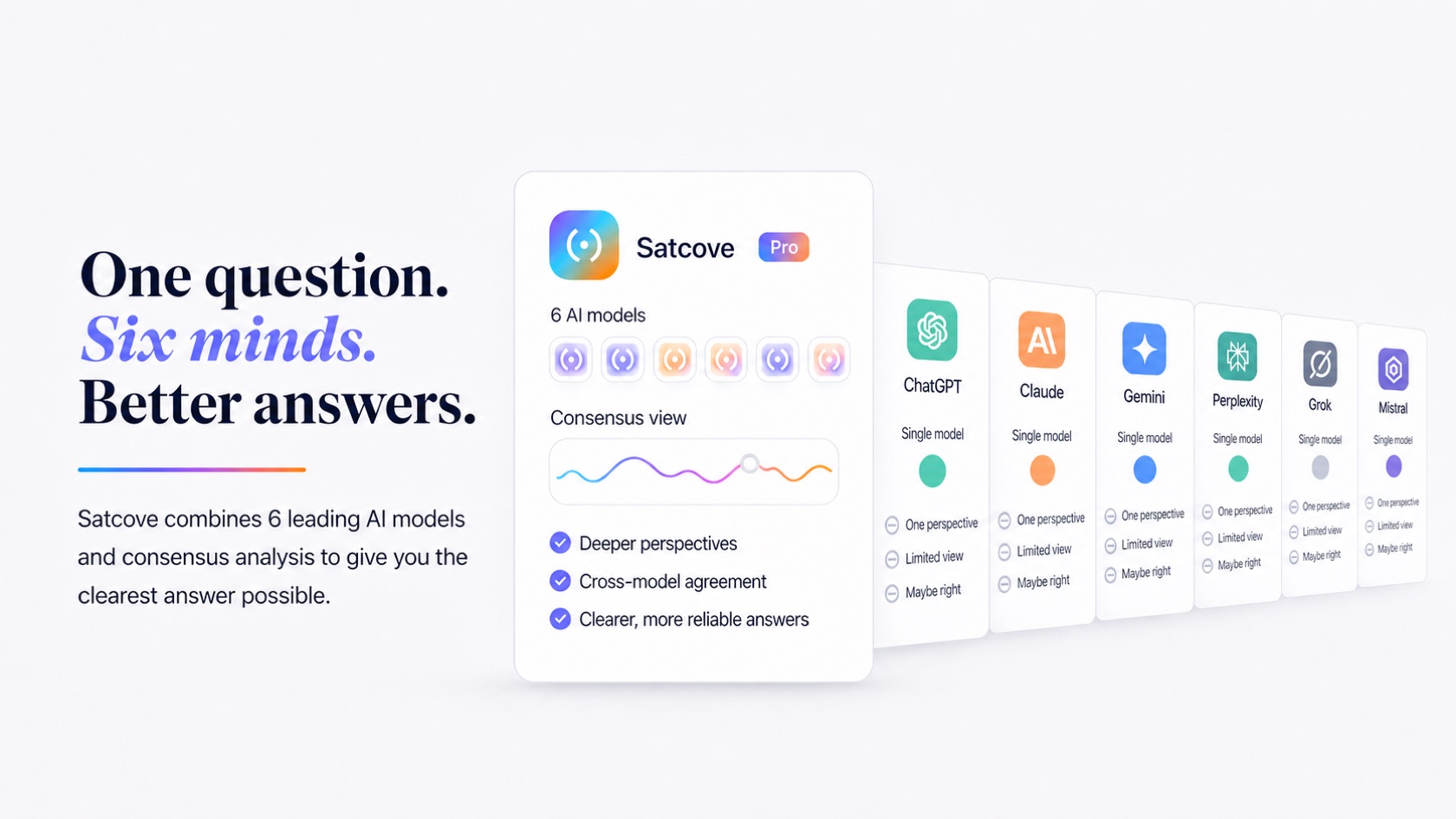
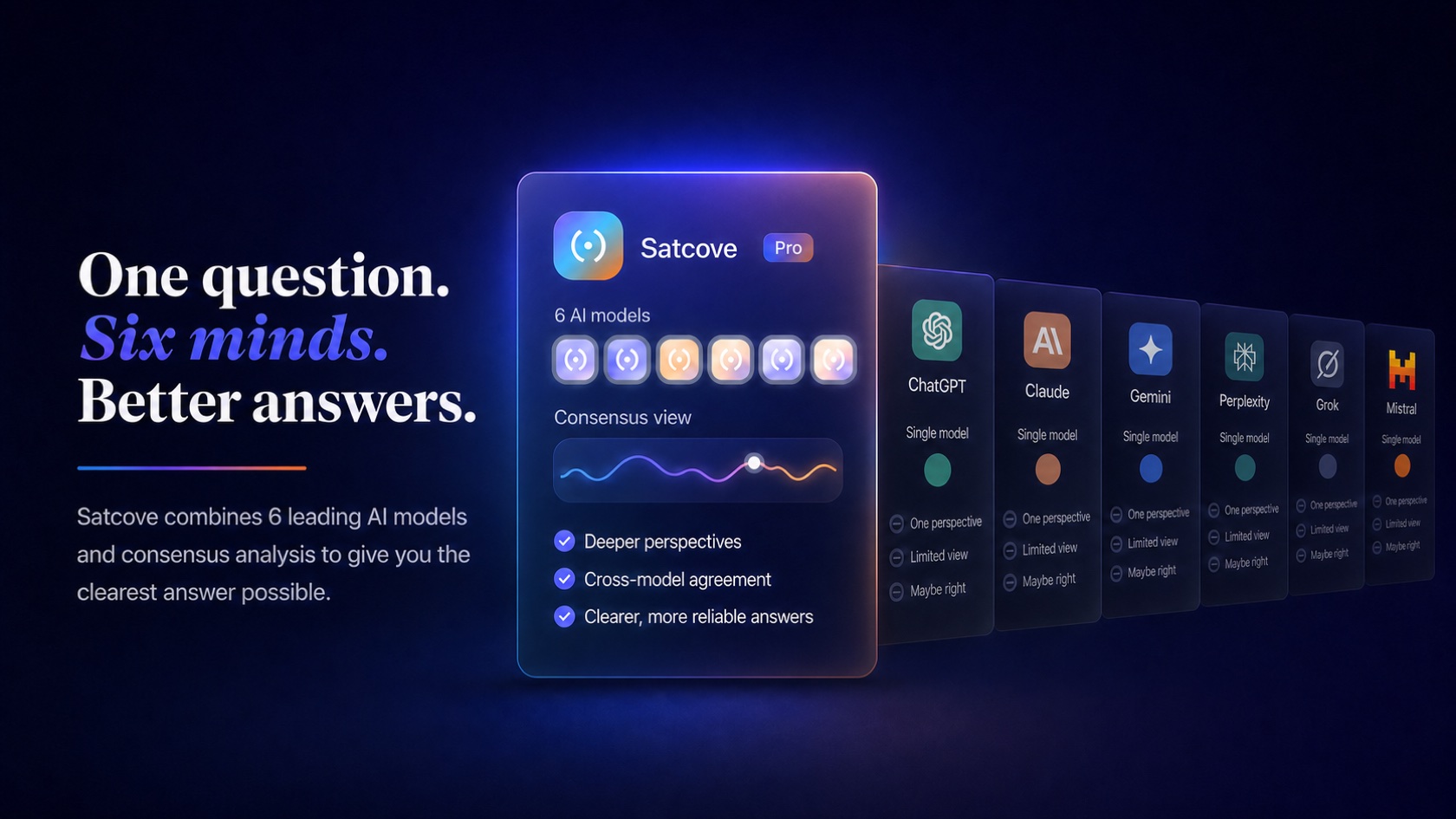
But "which AI should I use instead of ChatGPT?" is the wrong question. The best ChatGPT alternative in 2026 isn't another single chatbot — it's an engine that asks ChatGPT, Claude, Gemini, Mistral, Perplexity, and Grok the same question at once and shows you where they agree. Switching from one model to another just trades one set of blind spots for another. The reliable answer comes from consensus, not substitution.
Here's the full reasoning.
Why people look for a ChatGPT alternative
ChatGPT makes mistakes. Not often — but often enough to matter when the question is important. Hallucinations (confident, fluent, false answers) affect every large language model, ChatGPT included. And the model gives you no signal when it's wrong: a hallucination is delivered with the same confidence as a fact.
ChatGPT's training has a cutoff. It doesn't reliably know what happened last month. Perplexity solves this with live web retrieval, but introduces other tradeoffs around source quality.
Claude is sometimes better. On long-form text, nuanced analysis, and questions requiring careful reasoning, Claude frequently outperforms ChatGPT. But not always — and you can't know in advance which question falls into which bucket.
Gemini is sometimes better. On technical and scientific questions, Google's knowledge infrastructure gives Gemini a real edge.
Mistral and Grok add diversity. Mistral brings a European training distribution and strong multilingual performance. Grok adds a direct reasoning style and a different perspective. Each one is occasionally the model that gets a question right when the others miss.
The problem with classic alternatives
Switching from ChatGPT to Claude — or to Gemini, or to any single model — is exchanging one set of blind spots for another. Every model has strengths and weaknesses. No single model is universally best, and public benchmarks only measure average performance across thousands of questions. They tell you nothing about your specific question, in your domain, at this moment.
What you actually want is not a substitute model. It's a reliable answer, with a way to know how much to trust it.
The real alternative: all 6 AIs simultaneously
Satcove is a different category entirely. It's not another AI chatbot. It's the first multi-AI consensus engine: it simultaneously queries ChatGPT, Claude, Gemini, Mistral, Perplexity, and Grok, then synthesizes their answers into a single verdict.
Here's how it works:
- You ask your question once.
- All 6 AIs answer in parallel, independently — none of them sees the others' responses.
- Satcove analyzes the agreements and divergences across the six answers.
- You get one verdict with an agreement score (0–100%).
A high agreement score means six of the world's most capable AI systems — built by six different teams, trained on six different datasets — reached the same conclusion independently. A common error across all six is far less likely than an error from any one of them. A low score tells you the question is genuinely contested, and that you should dig deeper rather than trust a single confident answer.
In other words, Satcove doesn't just give you an answer. It tells you how much to trust it.
Beyond consensus
Replacing ChatGPT with consensus is the core, but Satcove does more than display six answers side by side.
- Deliberation. For high-stakes questions, the six AIs read each other's answers and must defend, challenge, or update their positions across three passes. A shallow answer collapses under scrutiny; a position that survives earns its place in the verdict.
- Privacy Shield. When you enable it on a supported text flow, Satcove attempts to replace common identifiers before model calls and restores placeholders where supported. It is available on every plan, including Free, but automated detection can miss contextual identifiers.
- Cove Fight. You can force two to six AIs to argue opposite sides of a topic, then read a verdict that names the decisive argument and the blind spot they all shared.
ChatGPT alternatives compared
| Solution | Reliability | Hallucinations | Real-time info | Transparency |
|---|---|---|---|---|
| ChatGPT alone | Good | Possible | Limited | None |
| Claude alone | Good | Possible | Limited | None |
| Gemini alone | Good | Possible | Better | None |
| Perplexity alone | Good | Lower | Excellent | Citations |
| Grok alone | Good | Possible | Good | None |
| Satcove (6 AIs) | Very high | Detected via divergence | Yes (Perplexity included) | Agreement score |
When Satcove is the right choice
Health questions where a hallucination has real consequences. When six independent AI systems agree on a medical fact, you can hold that answer with much higher confidence than any single model can offer.
Legal questions where jurisdictional nuances matter. The divergences between models often reveal exactly where your situation is ambiguous — which is precisely what you need to know.
Financial decisions where different models reflect different economic assumptions. Consensus means stability; divergence is an early warning that the question is uncertain.
Fact-checking anything you're about to act on. A low agreement score is a signal to slow down before you commit.
A single model is still fine for creative writing, brainstorming, simple code, and casual conversation — situations where being wrong costs nothing. Consensus is for when reliability matters.
A concrete example
Ask a jurisdiction-specific legal question — say, whether a particular asset transfer is allowed in an inheritance. Asked separately, two models can give directly opposite answers: one says it's legally possible, the other says it's impossible. With a single model, you'd walk away with false certainty.
With consensus, the agreement score drops sharply, and Satcove flags it explicitly: the models strongly disagree. Now you know the answer hinges on details of local law and that you need a professional. The disagreement isn't a failure — it's the single most useful thing the tool could have told you.
Pricing
- Free: 3 consensus queries/week for eligible new accounts, 10 messages — no credit card.
- Starter: €14.99/mo — 20 consensus/day, 30 messages/day.
- Pro: €39/mo — 30 consensus/day, Deliberation, advanced features.
- Pro Max: €99.99/mo — 50 consensus runs/day and Cove Board.
Privacy Shield is included on every plan, free included.
Frequently asked questions
What is the best alternative to ChatGPT?
The most reliable alternative isn't a single competing model — it's a multi-AI consensus engine that queries ChatGPT, Claude, Gemini, Mistral, Perplexity, and Grok at once and synthesizes one verdict with an agreement score. Satcove is the first product built around this approach.
Is Claude or Gemini better than ChatGPT?
Each is better on some questions and worse on others. Claude tends to excel at nuanced reasoning and long documents; Gemini at technical and scientific topics; Perplexity at current events. No single model wins universally, which is why consensus across all six is more reliable than picking one.
Can I replace ChatGPT entirely with Satcove?
For decisions where reliability matters — health, legal, financial, fact-checking — yes, consensus is a stronger tool than any single chatbot. For casual or creative use, a single model is perfectly fine. Many people use both.
Is Satcove free?
Yes. Eligible new Free accounts include 3 consensus queries per week with no credit card. Paid plans raise the limits and unlock Deliberation and other advanced features.
Does Satcove protect my data?
Yes. Privacy Shield removes personal information before any AI model sees your question, on every plan. Hosting is in the EU, data is encrypted (AES-256, TLS 1.3), and your conversations are never used to train any model.
The bottom line
Next time you're looking for a ChatGPT alternative, ask yourself the real question: do you want a different AI, or do you want the right answer?
A different model just moves your blind spots around. The right answer comes from asking all six leading AIs at once and reading their consensus.
Try Satcove free — or see what makes the approach unique at satcove.com/innovation.