Can you really solve a science problem by photographing it?
Yes. Point a phone camera at a physics diagram, a balanced-equation chemistry problem, or a multi-step algebra exercise, and several AI models will read the image and work through it — no retyping the problem, no guessing at the notation. That part is no longer the hard question.
The hard question is whether the answer you get back is actually right, and whether you'd know if it wasn't.
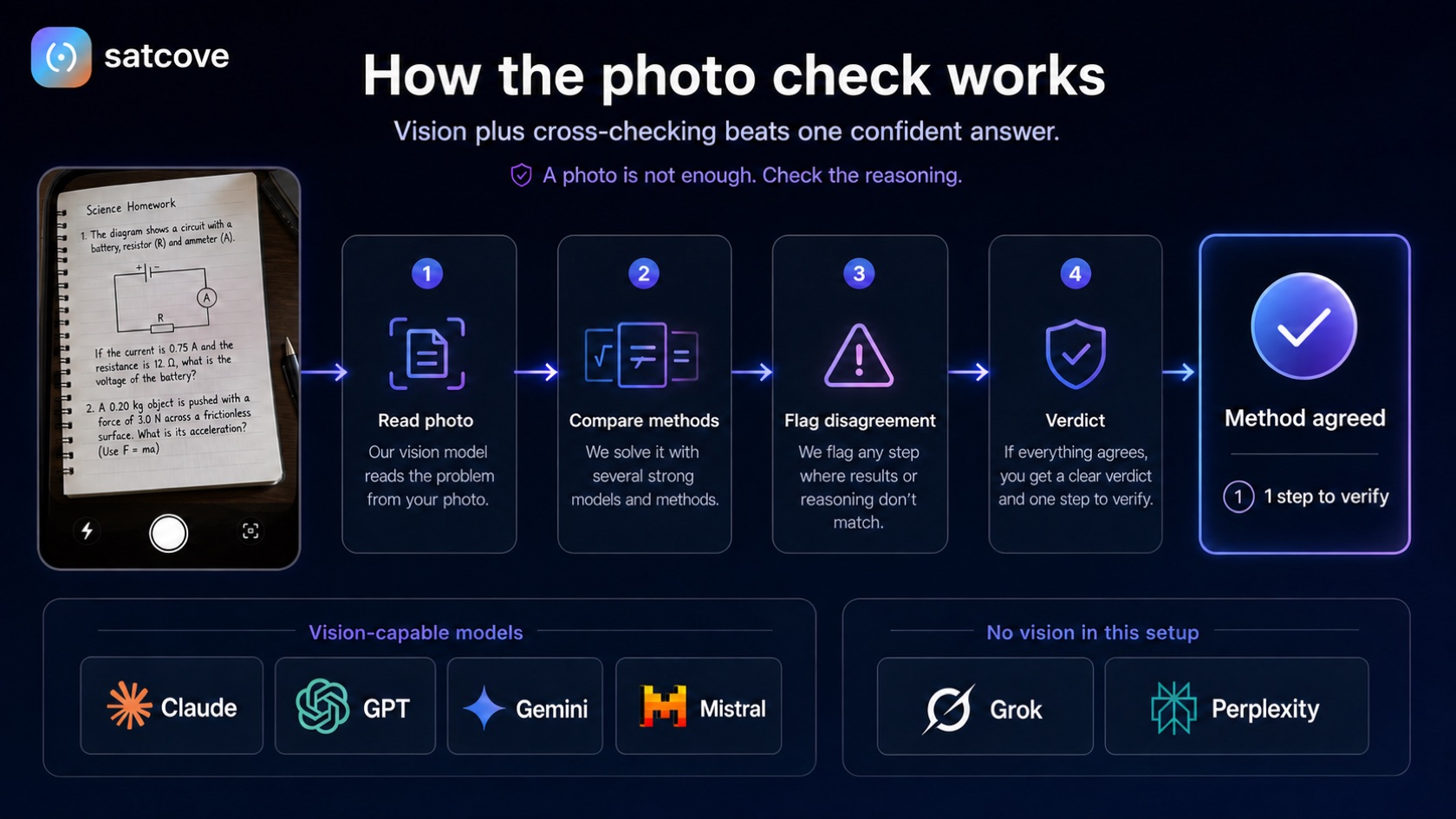
Not every AI model can see your photo
This is the detail that gets skipped in most "AI for homework" advice, and it matters more than which app you use. Vision — the ability to read an image at all, not just text — isn't universal across models:
- Claude, GPT, Gemini and Mistral read the photo directly and reason from what's in it.
- Grok and Perplexity currently have no vision in a standard multi-model setup — if a question includes only a photo and no transcribed text, they're answering blind, or not answering the actual problem at all.
If you're using a tool that claims to check your homework against "several AIs" or "a panel of models," it's worth knowing which of them actually looked at the picture. An answer generated without seeing the diagram isn't a second opinion — it's a guess dressed up as one.
Why one AI's solution isn't enough to trust
A worked science problem is a chain: read the given values, apply the right method, execute each algebraic or chemical step correctly, arrive at a number or a structure. A single silent break anywhere in that chain — a sign error, a misread exponent, a skipped unit conversion, a mismatched significant figure — produces a wrong final answer delivered with exactly the same confident tone as a right one.
That's the core problem with trusting one AI-generated solution: the model has no way to signal its own uncertainty. It doesn't hedge more on a hard problem than an easy one. A completely wrong derivation and a completely correct one can read identically confident.
What comparing models actually catches
Send the same photographed problem to more than one vision-capable model and you get something a single answer can never give you: a way to tell agreement from coincidence.
- If every model converges on the same method and the same final number, that's a meaningfully stronger signal than any one of them alone — a shared wrong assumption is possible, but far less common than one model making an isolated error.
- If the models split — same setup, different final answers, or worse, different methods entirely — that divergence points to exactly the step worth re-deriving by hand or bringing to a teacher. You're not fact-checking the whole problem from scratch; you're checking the one place where the models actually disagreed.
This is the same logic that applies to legal or financial cross-checking, just with a much shorter feedback loop: a physics problem has a definite right answer you can eventually verify, which makes the method easy to trust once you've seen it work.
Where this matters most: advanced science, not easy homework
The temptation is to assume AI homework help is mostly relevant for basic exercises. It's the opposite. On an easy problem, a wrong AI answer is usually obvious on inspection. On an advanced one — a multi-step thermodynamics derivation, an organic chemistry mechanism, a proof-based math problem typical of a prépa or first-year university course — a subtly wrong step can look completely plausible to someone still learning the material, which is exactly the situation where a second, independent read matters most.
The higher the level, the more a single AI answer should be treated as a first draft, not a submission.
What actually works, in practice
- Photograph the full problem, including any diagram, table or given values — a model that can't see the whole setup can't verify against it either.
- Send it to more than one vision-capable model. Don't assume a "6-AI" or "multi-model" tool means all of them processed the image; check.
- Read for agreement on method, not just the final number. Two models can land on the same numeric answer by different — and only one correct — routes.
- Treat divergence as a to-do list, not a failure. It tells you precisely which step deserves a second look, in your notes or with a teacher.
- Never submit an AI-derived result unchecked, especially past introductory level. The point of cross-checking is catching the error before it costs you, not skipping verification altogether.
How Satcove handles a homework photo
Upload a photo once. Satcove sends it to the vision-capable models in its panel — Claude, GPT, Gemini and Mistral — and compares their solutions step by step, showing an agreement score alongside any point where the method or the final answer diverges. Instead of trusting one AI's confident-sounding derivation, you see exactly where the models agree and exactly where they don't, before you write anything down as final.
It's a study aid built around the same idea as any good second opinion: independent checks catch what a single confident answer hides.